

How can we help today?
Choose an option to see quick actions and get help faster.Dehumidifier Installation in Morgantown, KY
Dehumidifier Installation in Morgantown, KY
Explore our whole-home dehumidification services in Morgantown to protect your home from moisture damage. Contact us for professional installation and financing options.
Resolve Chronic High Humidity Through Whole-Home Dehumidification
In Morgantown's humid summers, excess indoor moisture is more than a discomfort; it’s a health hazard that aggravates allergies and threatens the structural integrity of your home. From promoting mold growth to warping wood floors, uncontrolled humidity acts as a silent menace that standard air conditioning often cannot handle alone. Contact us today to discuss proper sizing for your home or to inquire about available financing options.
Carter Heating and Cooling specializes in integrating advanced dehumidification systems directly into your existing HVAC infrastructure to permanently resolve moisture issues.
- Achieve consistent indoor humidity levels between 30% and 50% for optimal comfort and health.
- Protect your home structure, drywall, and expensive furnishings from warping and moisture damage.
- Enhance your HVAC’s efficiency by reducing the latent heat load on your air conditioner.
Our professional installation ensures proper integration with your existing ductwork, backed by a comprehensive warranty for long-term peace of mind.
Integrating Dehumidification Into Your Central HVAC System
Many homeowners ask if a dehumidifier can be added to an existing HVAC system. The answer is yes, and it is the most effective method for controlling moisture across the entire square footage of a property. Unlike portable units that treat single rooms, a whole-house dehumidifier connects directly to your central heating and cooling system.
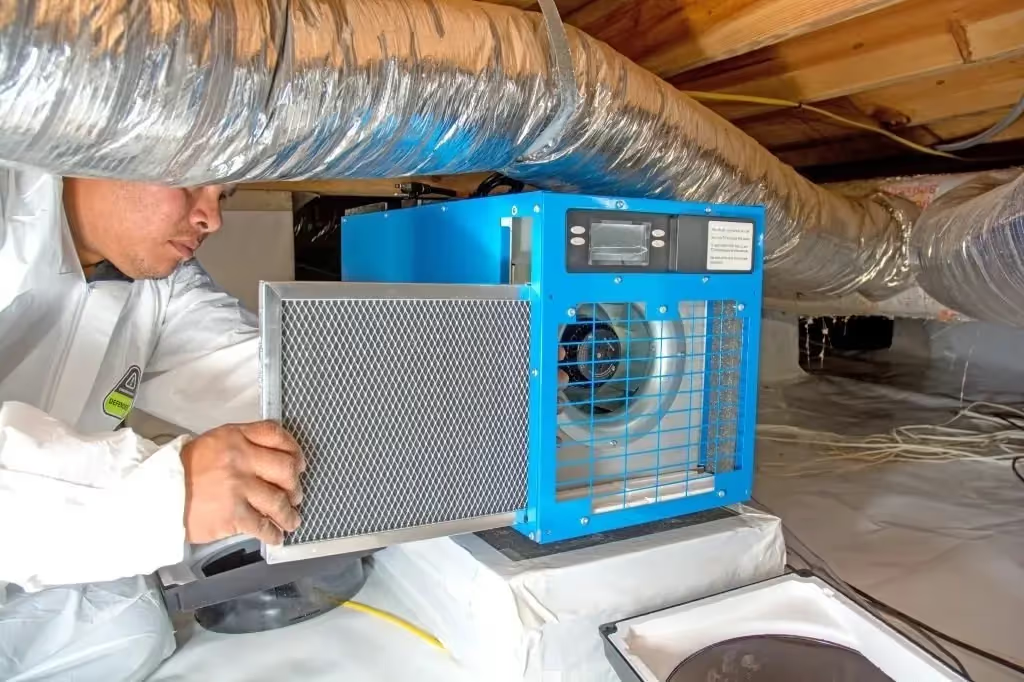
The equipment is typically installed in the basement, crawl space, or attic, near your indoor air handling unit. It works by drawing air from the house through the return ducts, removing the moisture, and then sending dry, filtered air back into the supply ducts to circulate throughout every room.
The Scope of Installation
Installing a dedicated whole-home unit involves specific technical modifications to your current setup. The process includes calculating the total volume of air in the home to select a unit with the correct pint-per-day removal capacity. An undersized unit will run continuously without achieving the set point, while an oversized unit may short-cycle.
Independent Operation Capabilities
A primary advantage of this installation is the ability to operate independently of the air conditioner. During the "shoulder seasons" in Morgantown—typically spring and autumn—temperatures may be mild enough that the AC does not run, yet humidity levels remain high due to annual precipitation averaging 48 to 55 inches.
A standard air conditioner only dehumidifies when it is cooling. If the thermostat is satisfied, the AC shuts off, leaving humidity to rise. A whole-house installation includes a dedicated humidistat or a smart thermostat integration that triggers the dehumidifier even when the AC is off. This ensures your home remains dry and comfortable regardless of the temperature outside.
Electrical and Drainage Requirements
The installation scope includes establishing a dedicated electrical connection to handle the amperage requirements of the unit. Furthermore, proper drainage solutions are implemented. Unlike portable units that require daily bucket emptying, a whole-house system is piped directly to a floor drain, a sump pump, or outdoors. This "set it and forget it" functionality is a key decision factor for homeowners upgrading their systems.
The Installation Process for Morgantown Homes
Professional installation follows a strict protocol to ensure efficiency and code compliance. Attempting to install these systems without professional HVAC knowledge often leads to airflow restrictions, static pressure issues, or voided equipment warranties.
Site Assessment and Load Calculation
- The process begins with a load calculation. Technicians measure the cubic footage of the home and assess the infiltration rate—how much outside air is leaking into the structure.
- The condition of the crawl space or basement is evaluated. If the crawl space is unsealed, it acts as a constant source of moisture. The installation plan may need to account for this additional load.
Ductwork Modification
- Technicians cut into the existing return and supply plenums to create a bypass or a dedicated return loop for the dehumidifier.
- Damper systems may be installed to direct airflow properly. This prevents the dry air from being short-cycled back into the dehumidifier, ensuring it reaches the living spaces instead.
- All duct connections are sealed with mastic or foil tape to prevent air leakage, which would compromise the system's efficiency.
Unit Placement and Vibration Isolation
- The heavy unit is suspended from joists using vibration isolation hangers or placed on a specialized pad to minimize noise transfer to the living areas above.
- Positioning is strategic to allow easy access for future filter changes and maintenance.
Electrical and Condensate Lines
- A dedicated circuit is run from the breaker panel if required by the manufacturer's specifications.
- Condensate lines are routed with the proper pitch to ensure gravity drainage. If gravity drainage is not possible due to the unit's location, a condensate pump is installed to move the water to an appropriate drain point.
System Configuration and Testing
- The humidistat is calibrated and set to the recommended level (usually around 45-50%).
- Technicians test the static pressure within the ductwork to ensure the new equipment does not restrict airflow for the furnace or air conditioner.
- The system is cycled through various modes to verify that it engages correctly when humidity levels spike.
Comparing Portable Units vs. Whole-House Integration
Homeowners often hesitate between buying multiple portable units or investing in a whole-house solution. While portable units have a lower upfront cost, they fail to address the root cause of humidity in a comprehensive manner. Understanding the functional differences helps clarify when a permanent installation is the necessary choice.
Efficiency and Coverage
- Portable units treat air in a limited radius. To mimic the effect of a whole-house system, a homeowner would need a unit in almost every room, significantly increasing electricity consumption.
- Integrated systems are rated for high-efficiency moisture removal. They remove more water per kilowatt-hour of electricity consumed compared to retail portable models.
- Centralized systems circulate dry air to all corners of the home, including closets and bathrooms where mildew is prone to grow.
Noise and Maintenance
- Portable dehumidifiers involve a compressor running inside the living space, generating significant noise.
- Whole-house units are located away from living areas, resulting in silent operation.
- Maintenance for integrated systems involves an annual filter check, whereas portable units require daily or weekly user intervention to empty water reservoirs.
Improving AC Lifespan
- By installing a central dehumidifier, the load on the air conditioner is reduced. Dry air feels cooler than humid air.
- This allows homeowners to set their thermostats a few degrees higher in the summer while maintaining the same level of comfort.
- Consequently, the AC compressor runs less often, reducing wear and tear and extending the lifespan of the primary cooling equipment.
Critical Signs Your Home Requires Dehumidification
Identifying when to move from repair or temporary fixes to a permanent installation is vital for protecting the home. Certain environmental cues in Morgantown homes signal that humidity has breached safe levels.
- Persistent Musty Odors: A lingering musty smell, particularly in basements or lower levels, indicates active mold or mildew growth, which requires humidity above 60% to thrive.
- Condensation on Windows: Frequent water droplets or fog on the inside of windows during summer or shoulder seasons suggest that indoor moisture is trapped and cannot escape.
- Warping Wood: Cupping wood floors, sticking doors, or cabinets that no longer close flush are signs that wood has absorbed excess moisture from the air.
- visible Mold Spots: Small black or green spots on ceilings (especially in bathrooms) or in corners of rooms indicate that the HVAC system is failing to keep the air dry enough to inhibit fungal growth.
- Clammy Feeling: If the air feels heavy or skin feels sticky even when the AC is running, the system is cooling the air but failing to remove the latent heat (moisture).
Navigating Local Climate and Code Requirements
Morgantown experiences a distinct four-season climate with a significant focus on humid summers and wet springs. This regional seasonality directly impacts how dehumidification systems must be configured.
Managing High Precipitation
With annual precipitation peaking in spring and summer, the ground surrounding foundations often remains saturated. Moisture migrates through concrete foundations and unsealed crawl spaces. A dehumidifier installation must account for this constant vapor pressure. In some local applications, pairing the installation with crawl space encapsulation is recommended to stop moisture at the source before it enters the ductwork.
Electrical Codes and Permits
Installing a hardwired appliance into the HVAC system constitutes an electrical and mechanical modification.
- Local building codes in Kentucky generally require that equipment connected to the electrical panel be installed by licensed professionals.
- Compliance ensures that the circuit is not overloaded and that all wiring meets safety standards to prevent fire hazards.
- Professional installers handle the permitting process, ensuring that the modification to the home is documented and legal, which is crucial for future home sales or insurance claims.
Utility Considerations
While adding an appliance increases total energy potential, the net effect often lowers utility bills. By allowing the main AC unit to run less frequently, the total energy consumption of the household balances out or decreases. Properly installed systems are Energy Star rated and designed to minimize amp draw.
Technical Superiority of Professional Installation
Choosing a professional for this service ensures that the investment actually solves the humidity problem rather than masking it. Retail units or DIY attempts often fail to account for static pressure, resulting in systems that are noisy and ineffective.
Warranty Protection
Manufacturers of whole-house dehumidifiers typically offer robust warranties on parts and compressors, often ranging from 5 to 10 years. However, these warranties almost universally contain clauses that require installation by a licensed HVAC contractor. DIY installation usually voids this coverage immediately.
Advanced Filtration
Many whole-house dehumidifiers come equipped with MERV-rated filtration capabilities. This means that while the system is drying the air, it is also capturing dust, pollen, and pet dander. It introduces fresh air ventilation options that can be regulated to dilute indoor pollutants, a feature not available in portable units.
The Carter Heating and Cooling Approach
Technical precision defines the workflow. The focus remains on the "Envelope" of the home—treating the house as a system where airflow, moisture, and temperature interact. By calculating the exact moisture load and verifying the ductwork capabilities, the system provides an immediate and noticeable change in indoor air quality.
Long-Term Asset Protection
A dry home is a preserved home. High humidity accelerates the degradation of building materials, causing drywall to crumble and metal fixtures to rust. The installation of a central dehumidifier is a capital improvement that extends the life of the property’s interior and structural components.
Book Today
Ensuring your home remains dry during the humid months protects your family and your investment. Eliminate the sticky, clammy air and prevent moisture damage permanently.
Secure your home against humidity today. Schedule your consultation to determine the right system for your property.

Great Service at a Fair Price
Veterans Discount


Senior Discount

Law Enforcement

Fire fighters/ems

Hear From Your Neighbors!
Hear from your neighbors to see how our commitment to dependable service and lasting comfort has made a difference in their homes.