
How can we help today?
Choose an option to see quick actions and get help faster.Ductless Repair in Bowling Green, KY
Ductless Repair in Bowling Green, KY
Struggling with ductless mini-split issues in Bowling Green? Ensure comfort with our specialized repair services. Fast, effective, and reliable solutions. Book now.
Eliminate Ductless Mini-Split Inefficiency and Breakdowns Immediately
With Bowling Green experiencing high humidity in the summer and freezing temperatures in the winter, a malfunctioning ductless system compromises your home's comfort and energy efficiency. You do not have to tolerate inconsistent temperatures, water leaks, or a system that refuses to turn on when you need it most. Contact Carter Heating and Cooling or apply for financing to schedule an emergency diagnostic today.
When a mini-split fails, it disrupts the precise zoning control you rely on. Specialized repair services address these issues at the source, ensuring your inverter-driven heat pump operates correctly.
- Restore system functionality immediately with certified technicians.
- Receive transparent, flat-rate pricing with no hidden fees.
- Benefit from fast response times to ensure minimal disruption to your home.
- Access repairs backed by industry-leading warranties and full compliance with local codes.
Comprehensive Diagnostics and Repair Scope for Zoned Systems
Ductless mini-split systems are technically distinct from standard central air conditioning. They rely on sophisticated inverter technology and complex communication between indoor air handlers and the outdoor condenser. When you request service, the objective is not just to patch a problem but to perform a comprehensive evaluation of the system’s electronics and mechanics.
Advanced Electrical Troubleshooting
A significant portion of ductless failures stems from electrical communication errors. Unlike traditional HVAC systems that use simple 24-volt thermostats, mini-splits use proprietary communication wires to send data between the indoor and outdoor units. Service technicians perform the following checks:
- Testing voltage consistency at the outdoor disconnect and the indoor head unit to ensure power stability.
- Inspecting the communication wire for degradation, loose connections, or rodent damage, which often causes "communication error" codes.
- evaluating the main circuit board (PCB). Inverter boards are sensitive to power surges; technicians verify if the board is sending the correct frequency to the compressor.
- Testing thermistors and sensors. These small components dictate how the system ramps up or down. If a sensor reads the temperature incorrectly, the system will not cool or heat effectively.
Refrigerant Leak Detection and Recharge
Ductless systems require a precise refrigerant charge to function. Even a minor leak can cause the coil to freeze or the compressor to overheat. The repair scope includes:
- Isolating the leak source using electronic leak detectors or nitrogen pressure tests. Common leak points include the flare connections where the line set meets the unit.
- Re-flaring the copper lines. Factory flares or poor installation often lead to slow leaks; technicians cut and re-flare connections to create a perfect seal.
- Weighing in the refrigerant charge. Unlike central units where "beer can cold" approximations might have been used in the past, mini-splits require the refrigerant to be weighed to the exact ounce matching the manufacturer's specifications.
Drainage and Moisture Management
In Bowling Green, high humidity levels mean your system removes significant moisture from the air. If the drainage system fails, water can damage your walls or flooring. Service includes:
- Clearing the condensate drain line. Algae and mold growth can block the narrow drain tubes common in mini-splits.
- Testing and replacing condensate pumps. Many wall-mounted or ceiling-cassette units rely on small pumps to lift water away. If this pump fails, the unit typically shuts down to prevent overflow.
- Deep cleaning the blower wheel. Dust and mold accumulation on the barrel fan inside the head unit creates an imbalance, leading to noise and reduced airflow.
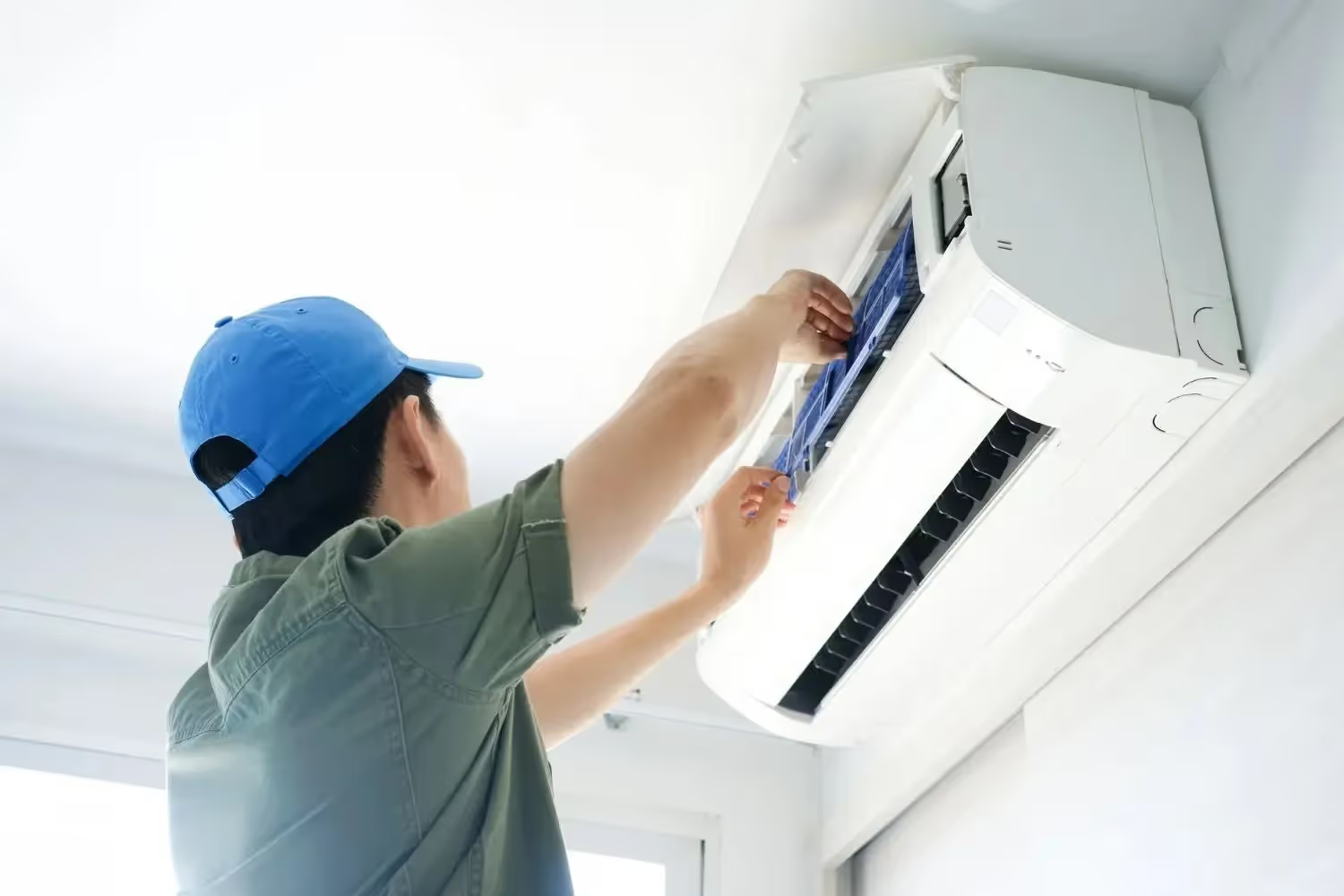
The Professional Repair Workflow: From Error Code to Resolution
Understanding the repair process helps you manage your time and expectations. A structured approach ensures that the root cause is identified and resolved without unnecessary delays.
Step 1: Error Code Analysis and Visual Inspection
The process begins with reading the specific error codes displayed on the unit or the remote controller. These codes provide a roadmap to the issue.
- Technicians decode the flashing lights or alphanumeric display to narrow down the fault (e.g., compressor lockout, high-pressure switch trip, or fan motor failure).
- A visual inspection checks for obvious signs of damage, such as oil stains indicating a leak or burnt wiring.
- Filters and coils are inspected to rule out airflow restrictions as the primary cause of the malfunction.
Step 2: System Isolation and Component Testing
Once the error is identified, the technician isolates the specific circuit or mechanical component.
- Power is disconnected to safely test electrical resistance and continuity on motors and compressors.
- Gauge manifolds are attached to measure operating pressures and line temperatures.
- Technicians verify the operation of the reversing valve, which is responsible for switching the system between heating and cooling modes.
Step 3: Quoting and Authorization
Before any wrench is turned for the actual repair, you receive a detailed explanation of the findings.
- The technician provides a clear, flat-rate price for the necessary repair.
- Options are presented if multiple solutions exist (e.g., repairing a leak vs. replacing the line set).
- Work proceeds only after you fully understand the scope and approve the service.
Step 4: Execution and Performance Verification
After the repair is completed, the system is not simply turned on and left.
- The system is run in maximum cooling or heating mode to force the inverter to ramp up to full capacity.
- Temperature splits (the difference between air entering and leaving the unit) are measured to verify efficiency.
- Current draw (amperage) is measured to ensure the compressor is running within safe limits.
- The work area is cleaned, and the remote control settings are verified.
Deciding Between Component Repair and System Replacement
Homeowners often face the difficult choice of whether to invest in repairs or replace the system entirely. While ductless systems are durable, certain factors dictate when a repair is no longer the most financial prudence move.
The Age and Refrigerant Factor
The lifespan of a well-maintained ductless system is typically 15 to 20 years.
- If your system is over 12 years old and requires a major component like a compressor, replacement is often more economical.
- Older systems utilizing R-22 refrigerant are obsolete. Parts are scarce, and the refrigerant itself is prohibitively expensive. If an R-22 system has a leak or compressor failure, replacement with a modern R-410A or R-32 system is the standard recommendation.
The Cost-to-Value Ratio (The $5,000 Rule)
A common industry benchmark is the $5,000 rule (or the 50% rule).
- Multiply the age of the equipment by the cost of the repair. If the total exceeds $5,000, replacement is generally the better option.
- Alternatively, if the repair cost is 50% or more of the cost of a new unit, replacement is recommended. New units come with fresh warranties, whereas a repair only guarantees the specific part changed.
Frequency of Breakdowns
Repeated failures indicate a system nearing the end of its life or one that was sized incorrectly at installation.
- If you have required repairs more than twice in the last two years, the system is likely becoming a money pit.
- Inverter boards are expensive. If a system blows multiple boards, it may indicate "dirty power" in the home or an aging compressor that is drawing too much current, signaling that a full system replacement is imminent.
Regional Factors Impacting Ductless Performance in South Central Kentucky
The climate and infrastructure in this region present specific challenges for ductless hardware. Understanding these local factors explains why certain failures occur and how they are addressed during repair.
Humidity and Biological Growth
The humid subtropical climate involves long periods of high moisture.
- Blower wheels in ductless units are prone to mold growth due to the combination of dust and moisture. This biological growth restricts airflow and reduces efficiency.
- Regular deep cleaning is not just for aesthetics; it is a mechanical necessity to prevent the blower motor from overheating due to the extra weight of the debris on the fan blades.
- Drain lines block more frequently here due to algae growth, requiring pressurized clearing or chemical treatment during service calls.
Winter Freeze and Defrost Cycles
Winters in the region see temperatures drop below freezing, which strains the heat pump capabilities.
- Ductless units must enter a "defrost cycle" to melt ice off the outdoor coil. If the sensors or control board fail, the unit will turn into a block of ice and stop heating.
- Technicians check the placement of the outdoor unit. It must be elevated above the anticipated snow line to prevent snow accumulation from blocking airflow or crushing the fan blades.
Electrical Infrastructure and Surges
Summer storms often bring lightning and power surges.
- Inverter boards are highly sensitive to voltage spikes. Many repairs involve replacing boards fried by storm activity.
- Repair services often recommend or include the installation of surge protectors specifically designed for mini-splits to prevent future catastrophic electrical failures.
Why Specialized Expertise Matters for Inverter Technology
Ductless systems are not "plug and play" appliances; they are complex thermal machines managed by advanced algorithms. A general handyman or a technician only familiar with traditional forced-air furnaces often lacks the specific diagnostic tools required for mini-splits.
Carter Heating and Cooling technicians utilize proprietary diagnostic tools and manufacturer-specific service manuals to pinpoint issues that others miss. Incorrect diagnosis leads to "parts changing"—replacing good parts in hopes of fixing the problem—which drives up costs and downtime.
- Proper Torque Specifications: Flare nuts must be tightened to exact torque settings. Overtightening cracks the brass, while undertightening causes leaks. Specialized torque wrenches are used for every connection.
- Communication Wire Integrity: Standard thermostat wire cannot be used for ductless communication. Technicians verify that the correct shielded, stranded wire is installed to prevent signal interference.
- Warranty Preservation: Most manufacturers void warranties if repairs are performed by uncertified personnel. Professional service ensures your parts warranty remains valid.
When your zoning system falters, you need a solution that addresses the root cause, respects your property, and restores the efficiency you paid for. Do not let a breakdown compromise your indoor climate control.
Contact Us Now
Restore comfort to your home instantly. Schedule your ductless repair service now.

Great Service at a Fair Price
Veterans Discount


Senior Discount

Law Enforcement

Fire fighters/ems

Hear From Your Neighbors!
Hear from your neighbors to see how our commitment to dependable service and lasting comfort has made a difference in their homes.