

How can we help today?
Choose an option to see quick actions and get help faster.Dehumidifier Repair in Morgantown, KY
Dehumidifier Repair in Morgantown, KY
Struggling with indoor humidity in Morgantown, KY? Contact Carter Heating and Cooling for expert dehumidifier repair and regain your comfort today.
Is Your Dehumidifier Failing to Control Indoor Humidity?
Is your home suffering from high humidity levels or musty odors even with a dehumidifier turned on? You might be dealing with a faulty unit needing immediate attention; contact us to schedule a diagnostic visit. Living in Morgantown, KY, means dealing with significant annual rainfall and humidity, making a functioning dehumidifier essential for protecting your property and health.
- Restore your home’s comfort with same-day dehumidifier repair services.
- Enjoy peace of mind with warranties on all repairs, ensuring long-term protection.
- Get expert solutions regardless of your dehumidifier's brand or model.
Licensed professionals are ready to deliver rapid, reliable repairs with proven results.
Comprehensive Diagnostics and Repair Services
When a dehumidifier stops collecting water or begins making unusual noises, the issue often lies deep within the mechanical or electrical components. Homeowners frequently notice that the fan is running, yet the humidity gauge on the wall or on the unit itself refuses to drop. This suggests that while the airflow system is operational, the moisture extraction process has failed. Carter Heating and Cooling provides comprehensive diagnostic services designed to pinpoint exactly why your system is failing to dehumidify your space.
The diagnostic process begins with a thorough evaluation of the humidistat. This sensor is the brain of the operation, telling the unit when to cycle on and off based on ambient moisture levels. If the humidistat is miscalibrated or broken, the unit may run continuously without condensing water, or it may fail to turn on at all despite the air feeling heavy and damp. We test these sensors for accuracy against professional-grade hygrometers to ensure they are reading the room correctly.
Another common failure point we address is the compressor and refrigerant system. Much like an air conditioner, a dehumidifier relies on a compressor to circulate refrigerant through cold coils. If the compressor has failed, or if there is a leak in the refrigerant line, the coils will never get cold enough to pull moisture from the air. You might see frost building up on the coils—a paradoxical sign that the system is low on refrigerant or lacking proper airflow. Our technicians are equipped to handle refrigerant leaks, recharge systems, and replace faulty capacitors that may be preventing the compressor from starting.
Electrical issues also plague aging units. Over time, vibration can loosen connections, and power surges can damage control boards. We inspect the internal wiring, the overflow safety switch (which prevents the unit from flooding your floor), and the fan motor. If the fan motor is burnt out or the bearings are seized, air cannot pass over the coils, rendering the unit useless. We stock a variety of universal and brand-specific parts to address these electrical failures quickly, minimizing the downtime of your equipment.
The Repair Process: From Assessment to Operation
Understanding how a professional repair is conducted helps set expectations for the service visit. We operate with a defined process that prioritizes accuracy and respect for your home. We do not rely on guesswork; every repair is based on data gathered from the specific unit.
Initial Assessment and Safety Check
The technician arrives and disconnects power to the unit to ensure safety. They perform a visual inspection of the exterior and filters, looking for blockages or obvious signs of damage. The technician then accesses the internal components to test voltage and resistance across motors, switches, and the compressor.
Component Isolation and Testing
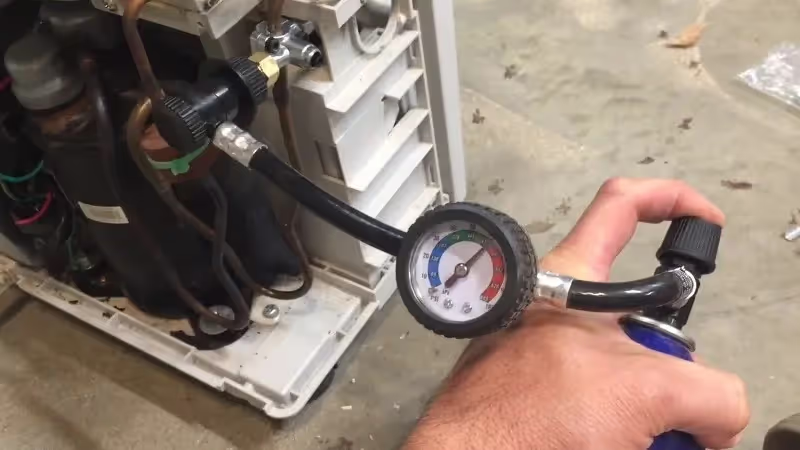
Using multimeters and manifold gauges, the technician isolates the specific point of failure. If the issue is a frozen coil, they check airflow restrictions first before hooking up gauges to check refrigerant pressures. This step-by-step isolation prevents unnecessary part replacement and ensures the root cause is identified, not just a symptom.
Clear Explanation and Approval
Once the problem is identified, the technician explains the issue in plain language. You receive a breakdown of what parts are needed and the timeline for the repair. No work proceeds without your understanding of what is broken and how we intend to fix it.
Execution of Repairs
The technician removes the faulty component—whether it is a seized fan motor, a bad relay, or a clogged drain line—and installs the new part. For refrigerant-related repairs, this involves brazing lines and vacuuming the system to remove contaminants before recharging it to factory specifications.
System Verification and Cleanup
After the repair is complete, the unit is powered on and forced into a run cycle. The technician monitors the amp draw and validates that water is being collected and drained properly. The work area is cleaned, and the unit is returned to its original position, fully operational.
Determining When to Repair vs. Replace
Deciding between repairing a broken dehumidifier and investing in a new system is a common dilemma. The decision usually hinges on the type of unit you have, its age, and the nature of the failure. Whole-home dehumidifiers and high-capacity crawl space units are significant investments, and repairing them is almost always more cost-effective than a full replacement. However, there are specific thresholds where replacement becomes the logical financial choice.
Consider the "50% Rule." If the cost of the repair approaches or exceeds 50% of the cost of a new unit, and the current unit is out of warranty, replacement is often recommended. This is particularly true for compressor failures in older, portable units where the labor and parts cost might outweigh the remaining lifespan of the machine. However, for integrated HVAC dehumidifiers, a compressor replacement is a standard procedure that extends the life of the system significantly.
Age is another critical factor. Most dehumidifiers have a lifespan of 5 to 10 years, depending on usage intensity. If your unit is nearing the 10-year mark and experiences a major failure, such as a refrigerant leak in the evaporator coil, it may be time to upgrade. Newer models are vastly more energy-efficient. An old, struggling dehumidifier can draw significantly more electricity to remove the same amount of water as a modern Energy Star-rated unit. By replacing an inefficient unit, you may offset the cost of the new equipment through monthly utility savings.
Refrigerant type also plays a role. Older units may use refrigerants that are being phased out or are expensive to source. If your unit requires a type of refrigerant that is no longer standard, the cost to recharge it may be prohibitive. In contrast, electrical issues like bad switches, control boards, or fan motors are almost always worth repairing, as these parts are generally affordable and restoring them returns the unit to full functionality immediately.
Regional Considerations for Moisture Control
Operating a dehumidifier in Morgantown requires an understanding of the specific local climate and housing structures. This region experiences a humid subtropical climate with significant precipitation spread throughout the year. With average annual rainfall hovering around 45 to 50 inches, the ground saturation levels remain high. This external moisture creates substantial vapor pressure, forcing water vapor through concrete foundations and into crawl spaces and basements.
Seasonality and Urgency
While summer brings the most obvious humidity due to heat, the shoulder seasons of spring and fall are equally critical in Kentucky. During these times, the HVAC system may not run enough to dehumidify the air naturally, yet the outdoor humidity remains high. A dedicated dehumidifier is often the only line of defense against mold growth during these months. Delays in repair during these windows can lead to rapid blooming of mold spores on floor joists and drywall.
Crawl Space Specifics
Many homes in the area are built on crawl spaces. In this region, an unconditioned crawl space can easily reach 80-90% relative humidity. We specialize in repairing the rugged, high-capacity units typically installed in these harsh environments. These units face different challenges than living-space units, including exposure to cooler ambient temperatures which necessitates robust defrost cycles. If the defrost sensor on a crawl space unit fails, the unit will turn into a block of ice, ceasing all function.
Drainage Logic
Given the volume of water pulled from the air in this climate, relying on a bucket that needs manual emptying is rarely feasible for whole-home solutions. Most repairs and installations here involve verifying condensate pumps and gravity drain lines. We ensure that these lines are clear of algae buildup—a common issue in our region—and that they are routed correctly to discharge water away from the foundation, adhering to local building standards regarding water disposal.
The Professional Advantage in Dehumidification
Attempting to repair a dehumidifier without professional training poses risks to both the equipment and the homeowner. These appliances combine high-voltage electricity with water collection, creating a hazardous environment for the untrained. Furthermore, the refrigeration circuit is a sealed system under high pressure. Handling refrigerant requires EPA certification and specialized tools to ensure that gases are recovered and charged without harming the environment or the technician.
Carter Heating and Cooling utilizes industrial-grade diagnostic tools that go beyond simple functionality tests. We measure superheat and subcooling to ensure the refrigeration cycle is perfectly balanced. This level of precision ensures that the unit not only runs but extracts the maximum amount of pints per day (PPD) rating it was designed for. An improperly charged unit might run and sound normal but fail to lower the humidity, wasting electricity and failing to protect your home.
We also verify the integrity of the airflow system. Dust and debris are the enemies of dehumidifiers. Over time, the internal coils can become impacted with particulate matter that standard filter changes miss. Our service includes deep cleaning of these components when necessary to restore thermal transfer efficiency. This attention to detail prolongs the life of the compressor and ensures quiet operation — view our maintenance plan for details.
Choosing a professional service means access to supply chains for OEM parts. Generic parts often do not fit correct specifications, leading to vibration, noise, or premature failure. We source components that match the engineering requirements of your specific model, ensuring that the repair holds up against the heavy workload required to keep a home dry in this climate.
Secure Your Home Against Moisture Damage
A broken dehumidifier is more than an inconvenience; it is an open invitation for moisture damage, wood rot, and poor indoor air quality. The humidity in our region is relentless, and your equipment needs to be running at peak performance to combat it. Do not let a minor mechanical failure escalate into a major structural problem or a mold remediation bill. Take control of your indoor environment today.
Contact us now to schedule your dehumidifier repair service.

Great Service at a Fair Price
Veterans Discount


Senior Discount

Law Enforcement

Fire fighters/ems

Hear From Your Neighbors!
Hear from your neighbors to see how our commitment to dependable service and lasting comfort has made a difference in their homes.