Why Your AC Coil Froze During Bowling Green's August Humidity Spike
Why Your AC Coil Froze During Bowling Green's August Humidity Spike
Dropping your thermostat won't remove heavy August moisture faster—it just pushes your equipment past its limits. See what causes your indoor unit to freeze solid and how to safely restore airflow.
If you have ever woken up to a warm, sticky house while your equipment runs nonstop, you are likely wondering why your AC coil froze during Bowling Green's August humidity spike. As families gear up for the back-to-school transition, that strange hissing sound from your utility closet, paired with vents that are barely breathing out room-temperature air, is a frustrating discovery. When you walk over to the indoor unit and see a thick block of solid ice encasing the copper refrigerant lines, the instinct our technicians see almost every day is the same: you head straight to the thermostat and drop the temperature even lower, hoping to force the system to finally cool the house down.
Here is the thing: dropping the temperature setting on your thermostat does not remove heavy moisture from the air any faster. In fact, doing so pushes your equipment far past its mechanical limits. During the intense August and late-summer mugginess, this specific freezing phenomenon is a recurring pattern our Carter Heating & Cooling team sees leaving homeowners uncomfortable and frustrated.
To truly resolve the issue, you have to understand that your cooling equipment is fighting a battle against moisture, not just heat. When a system is overwhelmed by thick, heavy air, it needs intervention, not a lower temperature setting. Properly functioning air conditioning systems are essential for managing this load, and understanding the root cause is the best way to avoid needing emergency AC repair in Bowling Green when the weather is at its worst.
The Reality of Bowling Green's High Dew Points
To understand why your system suddenly turns into a block of ice, you have to look closely at the specific climate conditions in Warren County. It is no secret that late summer in Kentucky brings a heavy, oppressive atmosphere. However, the true metric that dictates your indoor comfort—and your system's workload—is not the heat index, but the dew point.
During August, Bowling Green frequently experiences high dew points climbing well into the 70s. When the dew point reaches this level, the air is saturated with moisture. This high outdoor humidity inevitably infiltrates your home through doors, windows, structural gaps, and normal daily activities. As your local Warren County HVAC provider, our team at Carter Heating & Cooling responds to this exact weather-related phenomenon every single August. We see perfectly good systems fail simply because the indoor environment has become too saturated for the equipment to handle.
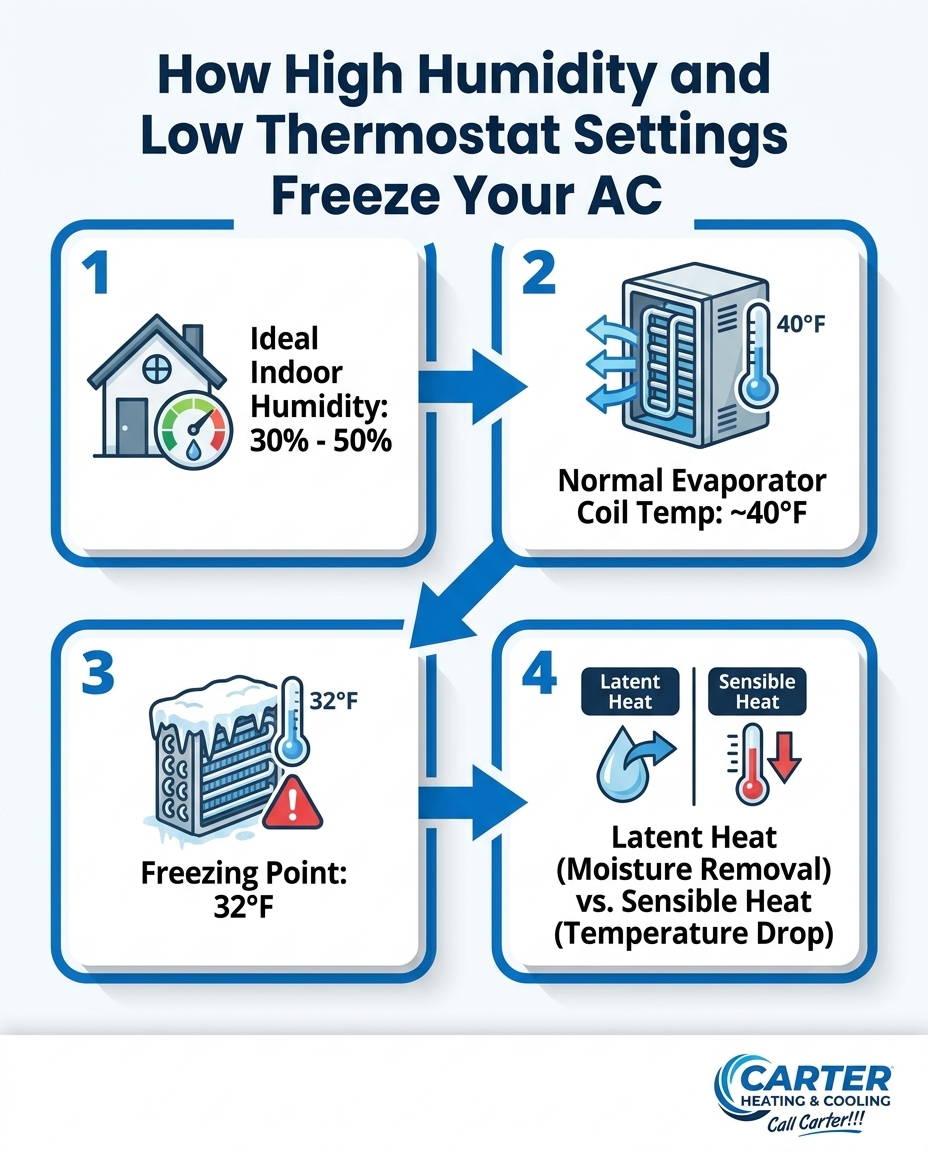
According to recommendations from the Environmental Protection Agency (EPA) and the Department of Energy (DOE), ideal indoor humidity should remain strictly between 30% and 50%. When the indoor humidity climbs to 60% or 70% during a late-summer mugginess streak, it creates a massive "latent cooling load" on your HVAC system. The equipment is forced to process gallons of water out of your indoor air before it can even begin to lower the actual temperature of the room. This heavy moisture burden is the primary catalyst for system freeze-ups.
Latent Heat vs. Sensible Heat: What Your AC is Actually Doing
To fully grasp why high humidity causes such a severe mechanical reaction, it helps to break down the physics of how your air conditioner actually operates. Your cooling system deals with two entirely different types of heat: sensible heat and latent heat. Most homeowners only think about sensible heat, which leads to confusion when the system stops working during a humid stretch.
• Sensible Cooling — What It Means: The process of lowering the actual, measurable temperature in the room (what you see on the thermostat). — How Your AC Handles It: The primary design function of a standard air conditioner. It cools the air by removing sensible heat.
• Latent Cooling — What It Means: The process of removing moisture (humidity) from the indoor air. — How Your AC Handles It: A secondary byproduct of the cooling process. The AC removes moisture as air passes over cold coils, but it is not a dedicated dehumidifier.
An air conditioner is designed primarily for sensible cooling. Its main job is to drop the temperature. Dehumidification is simply a helpful byproduct of that process. When indoor humidity spikes during August and late-summer mugginess, the physics inside your home change dramatically.
Because the air is so heavy with moisture, your AC spends the vast majority of its energy trying to remove that moisture (latent heat) rather than dropping the temperature (sensible heat). The thermostat does not register the moisture removal, so it keeps telling the system to run continuously. The system works overtime, extracting water from the air, but the temperature in the house barely budges. This continuous, exhausting cycle sets the stage for the evaporator coil to fail.
The 40-Degree Evaporator Coil and the Freezing Point
The transition from a working air conditioner to a frozen block of ice comes down to exact temperatures and continuous run times. Inside your indoor unit sits the evaporator coil, a series of copper tubes filled with cold refrigerant. Under normal operating conditions, this coil maintains a temperature of roughly 40 degrees Fahrenheit.
When warm, moist indoor air blows over this 40-degree metal coil, water condenses on the surface. You see this exact same physical reaction when you set a glass of ice water on a patio table in Bowling Green or Warren County during the summer—water beads up instantly on the outside of the glass. In your AC, this condensation normally drips down into a drain pan and flows safely outside your home.
However, when the system runs continuously to fight extreme high humidity, the dynamics change. Here is the step-by-step process of how a freeze-up occurs:
1. Continuous Extraction: The system runs without stopping, pulling massive amounts of moisture out of the humid indoor air.
2. Temperature Drop: Because the system never cycles off to rest, the continuous flow of refrigerant causes the evaporator coil's temperature to drop steadily below its normal 40-degree baseline.
3. Hitting the Freezing Point: The coil temperature eventually drops below 32 degrees Fahrenheit.
4. Instant Freezing: The heavy condensation coating the coil instantly turns to ice.
5. Airflow Blockage: As the ice builds up, it blocks the narrow fins of the coil, preventing warm air from passing through. This makes the coil even colder, accelerating the ice formation until the entire unit is encased.
How High Humidity and Low Thermostat Settings Freeze Your AC
Why Lowering the Thermostat Backfires
When the house feels warm and sticky, the most common behavioral mistake we see homeowners make during this end-of-season cooling stretch is walking over to the thermostat and dropping the setting to 65 degrees. The logic seems sound: if the house is hot, ask for more cold air. Unfortunately, a standard residential air conditioner only has one speed. It does not blow colder air or work harder when you lower the setting; it simply runs longer to try and reach that lower number.
During August and late-summer mugginess, lowering the thermostat just forces the system to run endlessly without a break. Because the heavy latent moisture prevents the room temperature from dropping quickly, the system never satisfies the thermostat. This continuous, unbroken cycle is exactly what drives the evaporator coil temperature below freezing, accelerating the ice buildup.
If you discover a frozen coil, you must resist the urge to fix it yourself through physical means. Never attempt to scrape the ice off the delicate fins of the evaporator coil, and never use a heat gun or hair dryer to melt the ice. The copper lines and aluminum fins are highly sensitive. Over the years, our team has had to replace countless ruined coils because physical scraping or intense direct heat caused catastrophic refrigerant leaks.
The only safe, immediate action you can take is to turn the cooling cycle completely off at the thermostat and switch the fan setting from "Auto" to "On." This allows warm indoor air to circulate over the frozen coil, melting the ice naturally and safely into the drain pan. Depending on the severity of the ice block, this natural thawing process can take anywhere from a few hours to an entire day.
Proper Humidity Management Strategies for Kentucky Homes
Managing the indoor environment correctly is the key to preventing your system from freezing solid. Because Bowling Green and Warren County experience such heavy moisture loads, you have to adopt strategies that help your equipment process humidity without pushing it to the breaking point.
Rather than drastically fluctuating your thermostat, keep it set to a moderate, consistent temperature. A steady setting of 72 to 74 degrees allows the system to cycle normally, giving the evaporator coil time to warm back up between cooling cycles. This natural resting period prevents the coil from dropping below the 32-degree freezing mark.
For homes that struggle with persistent moisture, relying solely on the AC is often not enough. Implementing dedicated indoor air quality solutions is the most effective way to protect your equipment. Consider these proven strategies:
• Whole-Home Dehumidifiers: These systems work alongside your HVAC unit to handle the heavy latent cooling load. By extracting moisture before the air reaches the AC coil, they prevent freezing and allow the AC to focus purely on dropping the temperature.
• Consistent Fan Settings: Keep the fan on "Auto" during normal operation so moisture has time to drain off the coil between cycles. Running the fan constantly while the AC is trying to cool can actually re-evaporate moisture back into the house.
• Sealing the Envelope: Ensure weatherstripping around doors and windows is intact to prevent the heavy outdoor humidity from constantly infiltrating your living space.
Proper moisture control improves your overall comfort significantly. When indoor humidity is maintained below 50%, a home set to 74 degrees feels drastically cooler and more comfortable than a humid home set to 68 degrees.
Secondary Triggers: Airflow and Maintenance Factors
While extreme high humidity is the primary catalyst for a frozen coil during August and late-summer mugginess, it rarely works alone. When our technicians diagnose a frozen system, we frequently find restricted airflow as the secondary trigger that rapidly accelerates the freezing process. For an air conditioner to function properly, it requires a massive, continuous volume of warm air moving over the evaporator coil. If that airflow is choked off, the coil temperature plummets instantly.
Blocked return vents are a common culprit. If furniture, rugs, or heavy curtains are blocking the large intake grilles in your hallways or living rooms, the system cannot pull in enough warm air to keep the coil above freezing. The system effectively suffocates, and the condensation turns to ice much faster.
The Role of Clean Air Filters
The most frequent cause of restricted airflow is a dirty, clogged air filter. When a filter is packed with dust, pet hair, and debris, it acts like a wall. It prevents the warm return air from ever reaching the evaporator coil. Without that warm air to balance the cold refrigerant, the coil temperature drops rapidly.
Filter changes are especially critical during high-usage months like August. When the system is running constantly to combat the heat and humidity, filters clog much faster than they do in the mild spring months. Checking and replacing your filter every 30 days during the summer is one of the simplest ways to prevent a frozen system.
Professional Refrigerant Checks
Another compounding issue that requires professional diagnosis is low refrigerant. It sounds counterintuitive, but a system that is low on refrigerant actually runs colder than it should. The drop in pressure causes the remaining refrigerant to expand too much, dropping the coil temperature below freezing.
If your system is struggling with humidity and freezing up despite having a clean filter and open vents, you might have a hidden leak. Having a licensed technician verify your charge levels through routine AC maintenance ensures that the system has the exact chemical balance required to handle the heavy latent load without freezing over.
FAQ
Why did my AC coil freeze on a hot humid day? Your AC coil froze because the system ran continuously to remove heavy moisture from the air, which caused the coil temperature to drop below 32 degrees. When warm, moist air hits a freezing coil, the condensation instantly turns to ice. This happens frequently when high humidity overworks the system without giving it a chance to cycle off and rest.
Does lowering the AC remove humidity? No, lowering the thermostat does not remove humidity faster; it only forces the system to run longer. A standard air conditioner operates at a single speed and cannot increase its dehumidification power just because the temperature setting is lower. Forcing the system to run endlessly in a humid home is a primary cause of frozen coils.
What should I do if my AC freezes? The most important immediate step is to turn the cooling cycle off at the thermostat and switch the fan setting to "On." This allows warm air to circulate over the ice, melting it safely into the drain pan. You must wait for the ice to melt completely before turning the cooling cycle back on, and you should check your air filter for clogs while you wait.
Does high humidity cause AC to freeze? Yes, high humidity is a major catalyst for AC freeze-ups because it forces the system to process gallons of water out of the air. This heavy latent cooling load keeps the system running constantly, driving the coil temperature down. If the system lacks proper airflow or is pushed too hard, that excessive moisture freezes solid.
Can I just scrape the ice off my evaporator coil? You should never attempt to scrape ice off an evaporator coil or use a heat source like a hair dryer to melt it. The aluminum fins and copper tubing are extremely fragile, and physical scraping will easily puncture the lines, causing a severe refrigerant leak. Always let the ice melt naturally using the system's fan.
How long does it take for a frozen AC to thaw on its own? A frozen AC unit typically takes anywhere from 4 to 24 hours to thaw completely, depending on the thickness of the ice block and the temperature of the house. Leaving the thermostat fan set to "On" while the cooling cycle is off will help speed up the natural melting process.
Understanding why your AC coil froze during Bowling Green's August humidity spike is the first step toward restoring your comfort. By managing your thermostat properly, ensuring clear airflow, and addressing heavy moisture loads, you can keep your system running smoothly. If you have let the unit thaw completely and it still struggles to keep up, it is time to schedule professional AC repair in Bowling Green to get your home back to a cool, dry, and comfortable state.
Contact Us
Thank you! Your submission has been received!
Oops! Something went wrong while submitting the form.
Analyzing Furnace Replacement Quotes: Independent Bowling Green Installers vs. Regional Chains
Did a routine fall maintenance visit turn into a high-pressure sales pitch? Discover how corporate overhead impacts your estimate and why a local second opinion matters.
What to Expect When Requesting 24-Hour Emergency AC Repair in Bowling Green on a Weekend
Losing your AC on a Friday night in August is stressful. We break down exactly how after-hours dispatch works, parts availability, and safe triage steps to take while you wait.
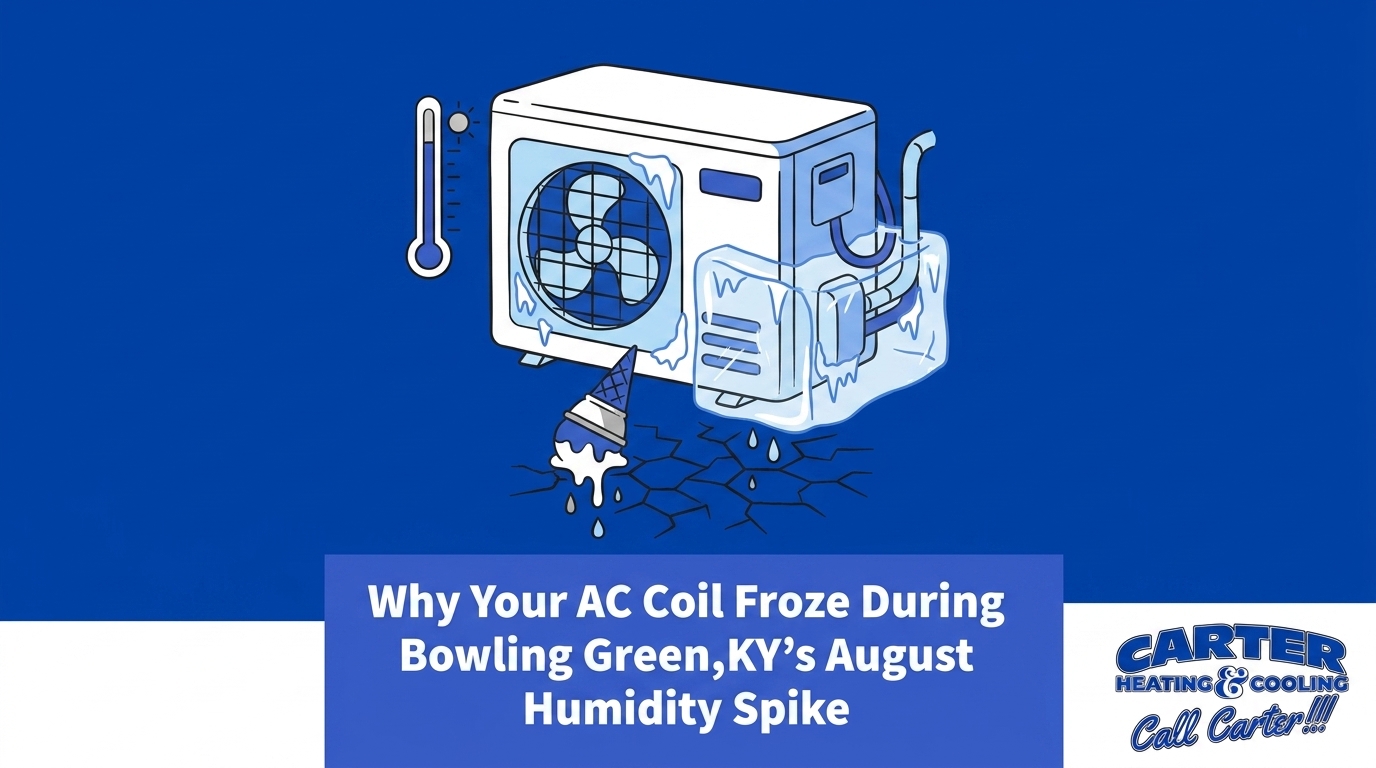
Why Your AC Coil Froze During Bowling Green's August Humidity Spike
Dropping your thermostat won't remove heavy August moisture faster—it just pushes your equipment past its limits. See what causes your indoor unit to freeze solid and how to safely restore airflow.