

The 3 Minute Rule AC and Heat Pump Guide: Decoding Fall Startup Delays
Smelling burning dust or facing a startup delay? See what triggers this safety pause and how home maintenance tips and troubleshooting keep your system safe.
Read More

How can we help today?
Choose an option to see quick actions and get help faster.The 3 Minute Rule AC and Heat Pump Guide: Decoding Fall Startup Delays
Smelling burning dust or facing a startup delay? See what triggers this safety pause and how home maintenance tips and troubleshooting keep your system safe.
It is a chilly October evening, you switch your thermostat to heating mode for the first time, and suddenly you are scrambling for home maintenance tips and troubleshooting advice because your system just shut down. That strange, faint burning smell and the sudden silence from your heat pump can easily trigger a wave of panic. You turn the system off out of caution, immediately switch it back on, and are met with a completely dead, unresponsive unit. Is your HVAC system actually broken right at the start of the mid-fall heating startup season, or is it simply protecting itself?
Before you assume the worst about your air conditioning systems and heat pumps, it helps to understand the hidden mechanical rules governing your equipment.
The first time you call for heat after months of cooling, your system undergoes a significant mechanical shift. Homeowners frequently misinterpret this transition as a catastrophic failure. A faint burning dust smell or unusual clicking noises from the thermostat often prompt people to rapidly flip the system off and on again. This rapid switching is exactly what triggers the system's built-in defense mechanisms.
The immediate sensory triggers:
• Unfamiliar odors: A temporary, dusty burning smell as elements heat up for the first time in months.
• Clicking sounds: The thermostat relays engaging to switch the reversing valve from cooling to heating.
• Sudden silence: The outdoor unit completely stopping and refusing to turn back on after a manual reset.
The decision point here is critical: figuring out if the system is experiencing a true mechanical failure or if it is simply executing a programmed delay. Understanding this difference prevents unnecessary stress and helps you make informed decisions about your home's comfort.
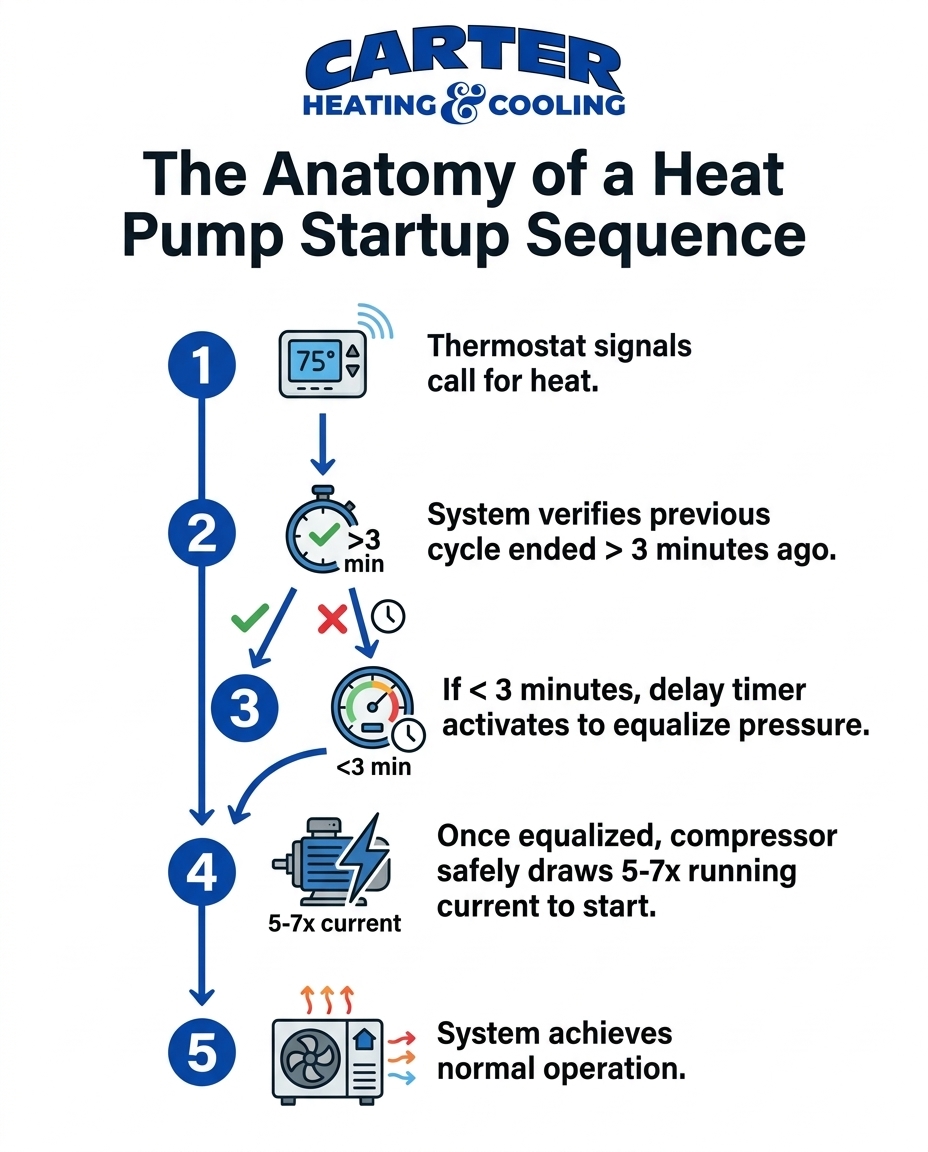
The short answer is that the silence you hear is intentional. Modern thermostats and control boards feature a mandatory time delay built directly into their programming. This is universally known in the industry as the 3-minute rule, and it acts as a non-negotiable safeguard for your most expensive HVAC component.
This rule applies specifically to the compressor, which functions as the mechanical heart of both air conditioners and heat pumps. The delay is triggered automatically anytime the system loses power, is manually turned off at the thermostat, or completes a standard heating or cooling cycle. It is an intentional, protective sequence of operations, not a failure to ignite.
With Bowling Green's fluctuating fall temperatures, your home's heating requirements can change drastically from morning to afternoon. These rapid temperature swings cause frequent system cycling between heating and off, making the 3-minute short-cycle timer highly active during October. Every time the system cycles down, the timer resets.
If you attempt to turn the system back on before this timer expires, the thermostat simply will not send the signal to the outdoor unit. The screen may flash "Wait" or "Delay," but the equipment will remain dormant. This is the exact difference between a normal ignition sequence vs. delayed ignition. A true delayed ignition is a mechanical failure to light; the 3-minute rule is a deliberate, programmed pause.
If you find yourself staring at a blank thermostat screen and worrying that you need AC repair in Bowling Green, take a step back and watch the clock. Giving the system a few minutes to reset is often the only "repair" required.
To understand why this delay is so rigid, we have to look inside the refrigerant lines. Heat pumps and air conditioners do not create heat or cold; they move heat from one place to another by manipulating the pressure of chemical refrigerant. This process creates extreme pressure differentials inside the system.
Carter Heating & Cooling prioritizes educating homeowners on these underlying mechanical principles to prevent avoidable breakdowns and save them money on emergency repairs. When you understand the science, the delay makes perfect sense.
While the compressor is running, it squeezes low-pressure refrigerant gas into high-pressure, high-temperature gas. This creates two distinct zones within your system:
• The High Side: Refrigerant under intense pressure, pushing through the coils to release heat.
• The Low Side: Refrigerant under much lower pressure, absorbing heat from the surrounding air.
When the unit shuts down—whether because the house reached the target temperature or because someone turned off the thermostat—these extreme pressure differences remain trapped inside the copper lines. The high side stays highly pressurized, and the low side remains low.
The physics of pressure equalization: It takes approximately three to five minutes for the refrigerant to bleed through the metering device and balance out across the entire system. This pressure equalization is absolutely required for the compressor motor to safely engage during the next cycle. If the pressures are unbalanced, the motor has to fight extreme mechanical resistance to start turning again.
It can be tempting to try and bypass the thermostat delay, especially if your house is cold and you are impatient for the heat to kick on. However, attempting to override this safety feature carries severe mechanical consequences for your heat pump.
Even under normal, equalized conditions, a compressor draws up to 5 to 7 times its normal running current during a standard startup. This massive surge of electricity is required to get the heavy internal motor spinning. Once the motor reaches its operating speed, the electrical draw drops back down to a manageable level.
If the motor attempts to start against unequalized pressure—meaning the 3-minute rule was bypassed or failed—the mechanical resistance is simply too high. The motor cannot overcome the trapped high-pressure gas, resulting in what HVAC technicians call a "locked rotor condition."
When a locked rotor occurs, several damaging things happen simultaneously:
• Massive electrical strain: The motor continues pulling maximum startup amperage because it cannot reach operating speed.
• Circuit breaker trips: The excessive electrical draw will quickly trip your home's circuit breaker to prevent a fire hazard.
• Overheated windings: The electrical windings inside the compressor rapidly overheat, which can melt their protective insulation.
• Permanent failure: Repeatedly starting against unequalized pressure will eventually cause permanent, unrepairable damage to the compressor.
Patience during the 3-minute delay prevents catastrophic damage. A mid-fall heating startup should be a smooth transition, not a mechanical stress test.
One of the main reasons homeowners panic and rapidly cycle their thermostats in the fall is the sudden appearance of strange smells. To avoid triggering the 3-minute delay unnecessarily, you need to be able to differentiate between harmless seasonal startup symptoms and actual mechanical failures.
During the long summer cooling season, your heating components sit idle. Dust naturally settles on heat exchangers, electric heating strips, and internal ductwork. When you activate the heat for the first time, these components get extremely hot very quickly. The distinct, temporary smell of dust burning off during the first few cycles of fall is completely normal and usually dissipates within 30 to 60 minutes.
Contrast this normal behavior with signs of true delayed ignition or electrical burning. If you are researching reasons a furnace needs to be reset, you should check your symptoms against this baseline:
• Smell — Normal Startup Behavior: Faint, dusty burning odor that fades within an hour. — Warning Sign of Failure: Acrid, melting plastic, or persistent electrical burning smells.
• Sound — Normal Startup Behavior: Standard relay clicks and steady fan operation. — Warning Sign of Failure: Loud booming, grinding, or continuous clicking without starting.
• Power — Normal Startup Behavior: System waits 3-5 minutes, then starts smoothly. — Warning Sign of Failure: System repeatedly trips the circuit breaker upon starting.
• Airflow — Normal Startup Behavior: Warm air begins flowing after the initial delay. — Warning Sign of Failure: System runs but blows cold air continuously.
Providing clear criteria for when a smell or sound crosses the line from a normal startup sequence to a warning sign empowers you to monitor your system safely.
Knowing the mechanics behind the 3-minute rule is helpful, but you also need exact, actionable criteria to decide if professional intervention is required. If your system is acting up during a mid-fall heating startup, follow a structured approach before making an emergency call.
1. Leave the thermostat alone: Once you set it to heating, step away. Wait the full 3 to 5 minutes without touching any buttons or flipping any switches.
2. Verify the settings: Ensure the thermostat is set to "Heat" and the temperature is adjusted at least three degrees above the current room temperature.
3. Monitor for normal airflow: After the delay expires, listen for the outdoor unit to engage and check your indoor vents for steady, warm airflow.
4. Check the breaker: If nothing happens after 10 minutes, check your home's electrical panel to see if a breaker has tripped.
When to call a professional: If the system remains completely unresponsive after 10 minutes, if the breaker continuously trips when the unit tries to start, or if a harsh burning smell persists for hours, it is time to call for help. Do not attempt to bypass safety controls.
We strongly advise against opening sealed combustion chambers or testing high-voltage electrical components without a license. Modern HVAC systems carry lethal voltage and require specialized diagnostic tools.
A typical pattern we see during the autumn season is homeowners scheduling routine AC maintenance and heating inspections to prepare for the cold. During these visits, technicians inspect the internal components, change the air filters, and verify that all safety delays and compressor functions are operating correctly, confirming the unit is fully ready for the season.
Your thermostat displays a "wait" or "delay" message to indicate that the short-cycle protection timer is active. This 3-minute pause allows the high and low-pressure refrigerant gasses inside the system to equalize safely. Without this delay, the compressor motor would have to work against extreme mechanical resistance, which could cause permanent damage. Once the timer expires, the system will start automatically.
Heat pumps utilize the exact same compressor technology as air conditioners, meaning they require the same pressure equalization period. Whether you are switching into heating mode for the winter or cooling mode for the summer, the internal pressures must balance out after the previous cycle. This delay ensures the motor can draw a normal amount of electrical current during startup without overheating.
Turning a heat pump on and off rapidly traps high-pressure refrigerant in the compressor lines, creating a locked rotor condition. If the system attempts to start under these conditions, it will draw an excessive electrical load, often up to 7 times its normal running current. This massive surge will typically trip your circuit breaker and can severely damage the electrical windings inside the compressor motor.
You should never attempt to bypass a thermostat delay, as doing so removes the primary safety mechanism protecting your compressor. While some technicians have specialized tools to override delays during professional diagnostics, homeowners should always let the 3-to-5-minute timer expire naturally. Forcing a startup against unequalized pressure is a leading cause of premature compressor failure.
Yes, a faint burning dust smell is entirely normal during the first few heating cycles of the fall season. Dust and debris settle on the internal heat exchangers and electric heating elements during the summer months when they are not in use. As these components heat up for the first time, the settled dust burns off, creating a temporary odor that should fade within an hour.
Understanding the mechanical "why" behind your HVAC system's behavior transforms a moment of panic into a moment of patience. A 3-minute delay is not a sign of failure; it is a clear indicator that your system is smartly protecting itself through pressure equalization. By recognizing the difference between harmless dust burn-off and genuine warning signs, you can approach the mid-fall heating startup with confidence.
Proactive preparation is the best way to avoid mid-winter surprises. If you are still relying heavily on home maintenance tips and troubleshooting guides because your system's startup sequence feels abnormal, it is always best to let a professional investigate. Comprehensive seasonal maintenance ensures that every safety delay, compressor motor, and electrical connection is fully prepared to keep your home comfortable all season long.
Hear from your neighbors to see how our commitment to dependable service and lasting comfort has made a difference in their homes.

Ready to Transform Your Home?
Discover our exceptional home services tailored to meet your need and enhance your living space.
Smelling burning dust or facing a startup delay? See what triggers this safety pause and how home maintenance tips and troubleshooting keep your system safe.
Did a routine fall maintenance visit turn into a high-pressure sales pitch? Discover how corporate overhead impacts your estimate and why a local second opinion matters.
Losing your AC on a Friday night in August is stressful. We break down exactly how after-hours dispatch works, parts availability, and safe triage steps to take while you wait.