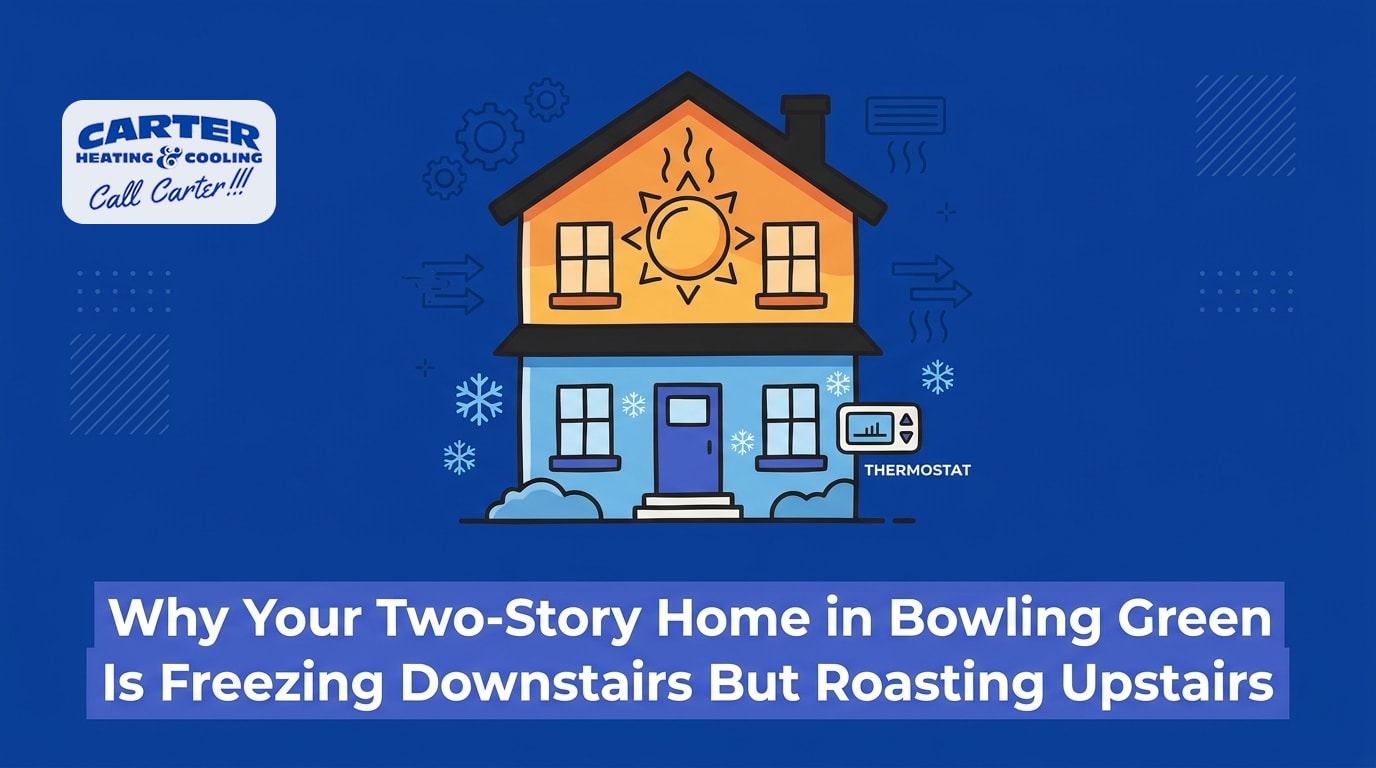
Why Your Two-Story Home in Bowling Green Is Freezing Downstairs But Roasting Upstairs
Why Your Two-Story Home in Bowling Green Is Freezing Downstairs But Roasting Upstairs
Wearing a sweater downstairs while your upstairs feels like a sauna? We explain the physics behind this temperature imbalance and the airflow solutions that safely restore comfort.
The Pre-Winter Chill: Facing the Two-Story Heating Dilemma
November is finally here, and as the late fall, pre-winter heating season settles in, you are likely turning on your furnace for the first time. But almost immediately, a familiar and deeply frustrating pattern returns. You are left wondering why your two-story home in Bowling Green is freezing downstairs but roasting upstairs. At Carter Heating & Cooling, we hear this exact complaint from local homeowners every autumn: you find yourself needing a heavy sweater just to watch television in the ground-floor living room, while the upstairs bedrooms feel like a stifling sauna.
This temperature imbalance is a concrete problem that makes your home uncomfortable and drives up your energy bills. You now face a critical decision: how do you address this massive temperature swing without resorting to damaging DIY methods? In our years of servicing local HVAC systems, we have found that the root cause usually comes down to three hidden factors: the natural physics of how air moves, the original design of your ductwork, and the location of your thermostat. Fixing it requires a professional understanding of airflow.
The quick fix: If you are tired of battling uneven temperatures, upgrading your heating systems or installing a targeted mini-split system can finally bring balanced comfort to your entire home. Keep in mind that federal tax credits and utility incentives may apply to qualifying high-efficiency installations, so we always recommend verifying current programs with your utility provider or a tax professional.
The Stack Effect: The Physics Behind Uneven Temperatures
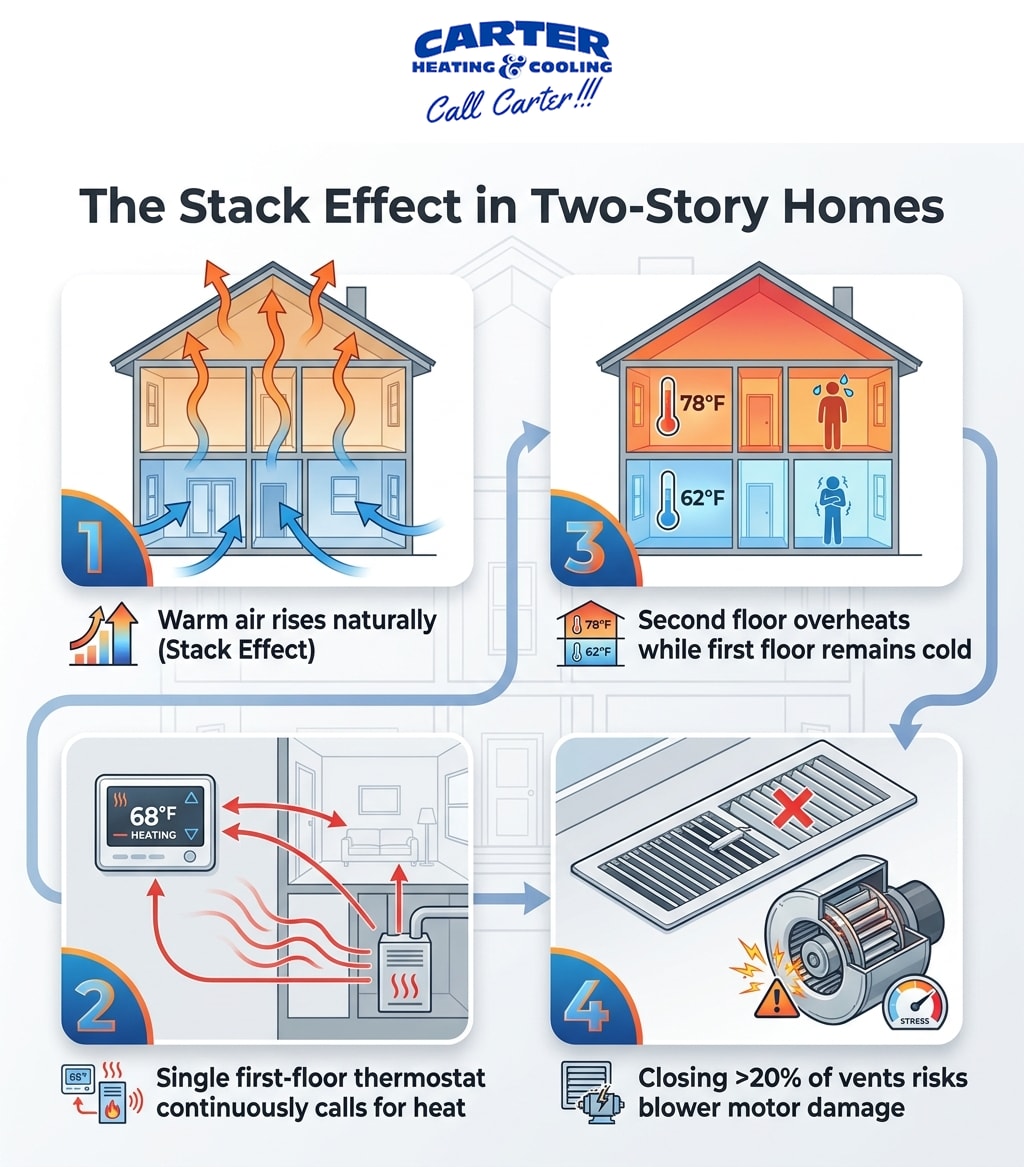
To fix the problem, you first have to understand the science behind it. When our technicians diagnose uneven heating, the primary culprit is almost always a natural physical phenomenon known as the "stack effect." Warm air is naturally buoyant. Because heated air molecules spread out and become less dense, they naturally rise to the highest point in an enclosed space. As that warm air rises to your second floor and attempts to escape through the attic, it creates negative pressure—a vacuum—on the lower levels.
This vacuum actively pulls cold, dense air into your first floor through microscopic gaps around doors, windows, and the foundation. Standard single-zone HVAC systems are rarely designed to combat this powerful natural force. They simply pump warm air into the house, and physics takes over from there.
With Bowling Green's winter temperatures frequently dropping below freezing, your single-zone furnace has to run continuously just to keep up with the cold. This non-stop operation rapidly accelerates the stack effect. The furnace pumps massive volumes of heat into the home, which immediately rushes to the upper levels, leaving the ground floor drafty and cold.
The Stack Effect in Two-Story Homes
Why Warm Air Abandons the First Floor
The layout of a typical multi-story house practically encourages heat to abandon the ground level. Open stairwells act exactly like giant chimneys, providing a massive, unobstructed pathway for warm air to rush upward. Vaulted ceilings on the first floor also trap heat high above your head, far out of reach of where you are actually sitting.
• Second Floor — Airflow Behavior: Traps rising warm air — Pressure Dynamic: Positive pressure (pushes air out) — Temperature Tendency: Overheats quickly
• First Floor — Airflow Behavior: Loses warm air upward — Pressure Dynamic: Negative pressure (pulls cold air in) — Temperature Tendency: Remains persistently cold
The Thermostat Trap: Why Single-Zone Systems Struggle
In our experience, most two-story homes feature a single thermostat, usually mounted on a wall in a first-floor hallway or living room. This single-zone setup is fundamentally flawed when dealing with multi-level physics. Your thermostat is essentially a blind sentry; it only knows the temperature of the exact square foot of air touching it.
This creates a frustrating and endless cycle. The downstairs thermostat reads the cold air pooling on the first floor and signals the furnace to turn on. The furnace dutifully fires up and pumps heat into the ductwork. Because of the stack effect, that heat immediately rises up the stairwell to the second floor. Meanwhile, the first-floor thermostat still reads a cold room, so it tells the furnace to keep running. The first floor stays chilly, the furnace stays on, and the upstairs bedrooms receive a continuous, unwanted blast of heat until they are sweltering.
To break this cycle, you have to change how the system reads the home's temperature. Upgrading to smart thermostat placement introduces remote sensors that can be placed in upstairs bedrooms and downstairs living areas. This allows the system to average the temperature across the whole house or prioritize the specific rooms you are actively using, rather than relying on one false reading from a drafty hallway.
• Hallway drafts: Cold air dropping down the stairs tricks the sensor into running the heat longer.
• Direct sunlight: A thermostat in a sunny spot shuts the heat off too early, freezing the rest of the house.
• Proximity to vents: If a supply vent blows directly on the thermostat, it constantly short-cycles.
The Ductwork Dilemma: Leaks, Insulation, and Airflow
Your thermostat is only part of the equation. Our installation crews frequently discover that hidden flaws in ductwork contribute heavily to the loss of heat on the first floor. According to U.S. Department of Energy (DOE) guidelines, a typical home loses a significant percentage of its heated air through leaky ducts before that air ever reaches its destination.
If the ductwork running to your first-floor rooms has disconnected joints, unsealed seams, or crushed sections, the warm air simply leaks out into your crawlspace or basement. By the time the air reaches the living room vent, there is barely any pressure left to push it into the room.
Furthermore, inadequate insulation in your attic allows the heat that does make it upstairs to escape the home entirely. When heat escapes through the roof, it strengthens the vacuum effect downstairs, drawing even more freezing outside air into your ground-floor living spaces.
Many homes also suffer from poorly designed ductwork bottlenecks. If the main trunk line is undersized, the blower motor simply cannot push enough volume to reach the furthest rooms on the ground floor. Diagnosing these hidden, structural issues requires professional airflow testing. Improving your indoor air quality and airflow means finding these invisible leaks and ensuring the blower can actually deliver warm air where it belongs.
The Dangerous DIY Myth: Why Closing Vents Causes Damage
When dealing with the frustrating search pattern of a home that is freezing downstairs and roasting upstairs, many homeowners make a very logical assumption. They assume that by closing the supply vents in the hot upstairs bedrooms, they will force the warm air to redirect and blow out of the downstairs vents instead. As HVAC professionals, we strongly advise: Do not do this.
HVAC systems are carefully balanced to move a specific volume of air. This brings us to the 20% rule: closing more than 20% of a home's HVAC vents drastically increases the static pressure inside the ductwork. Think of your ductwork like a giant straw. If you blow into the straw and pinch the end closed, the pressure backs up immediately.
When you close upstairs vents, the blower motor in your furnace has to work incredibly hard to push air against that trapped pressure. This severe strain causes the blower motor to overheat, leading to premature failure and expensive repairs. Even more alarming, restricting airflow means less air passes over the furnace's heat exchanger. Without enough air to cool it down, the heat exchanger can overheat, warp, and eventually crack. A cracked heat exchanger is a major safety hazard that can leak carbon monoxide into your home.
Never try to balance your home's temperature by closing vents. It is a dangerous DIY myth that does not solve the underlying physics problem and puts your expensive equipment at serious risk.
Professional Solutions for Balanced Whole-Home Comfort
If closing vents is off the table, how do you actually achieve balanced comfort? The answer lies in professional, engineered solutions that address the physics of airflow directly. As a homeowner, you have several safe and highly effective options to correct a multi-story temperature imbalance.
The most comprehensive solution we recommend is installing an HVAC zoning system. Zoning uses motorized dampers installed directly inside your ductwork, controlled by multiple thermostats on different floors. When the upstairs gets too warm, the dampers automatically close off airflow to the second floor, redirecting the system's full capacity to the first floor until the temperature balances out.
Another excellent option is a ductless setup. Installing ductless units in the upper-level bedrooms provides localized, independent control. You can keep the upstairs bedrooms cool and comfortable for sleeping, while allowing your main central system to focus entirely on warming the downstairs living spaces.
In some cases, the original ductwork requires professional modification and balancing to correct original design flaws. Carter Heating & Cooling brings specific local expertise to Bowling Green two-story homes, diagnosing and resolving these exact airflow, ductwork, and thermostat placement issues safely and effectively. We measure the static pressure, calculate the load, and design a solution that actually works.
If your current furnace is aging and you are considering a replacement to solve these issues, comparing heat pumps and gas furnaces is an excellent next step to determine which technology will best handle your home's multi-level heating demands.
1. Load Calculation: A professional assesses how much heat each specific room requires based on windows, insulation, and layout.
2. Static Pressure Testing: Technicians measure the resistance inside your ductwork to ensure the blower motor is operating safely.
3. Airflow Balancing: Adjustments are made at the ductwork dampers (not the room vents) to distribute air evenly.
4. System Customization: Zoning controls or ductless units are integrated to provide independent temperature management for each floor.
Frequently Asked Questions About Two-Story Heating
Why is my downstairs cold and upstairs hot in winter?
Your downstairs is cold and your upstairs is hot primarily due to the stack effect, where warm, buoyant air naturally rises to the second floor. Because most two-story homes only have one thermostat located on the first floor, the system continuously pumps heat to warm the cold lower level, which immediately rises and overheats the upstairs.
How do I balance the heat in a two-story house?
You can balance the heat in a two-story house by installing a professional HVAC zoning system, adding smart thermostat sensors to multiple rooms, or utilizing ductless units for upper bedrooms. These professional solutions allow you to control the airflow and temperature of each floor independently, overcoming the natural physics of rising heat.
Does closing vents help push heat downstairs?
No, closing vents does not effectively push heat downstairs. Instead of redirecting the air, closing vents blocks the airflow and drastically increases the static pressure inside your ductwork, which traps the air and forces your system to work harder with no real benefit to the lower level.
Is it safe to close upstairs vents to push heat downstairs?
It is not safe to close upstairs vents to push heat downstairs because the resulting high static pressure can severely damage your HVAC equipment. Blocking airflow strains the blower motor until it fails and can cause the furnace heat exchanger to overheat and crack, creating a serious safety hazard.
Can a single-zone thermostat effectively heat a two-story home?
A standard single-zone thermostat inherently struggles to heat a two-story home effectively because it only measures the temperature in one specific location. Without multiple sensors or zoning dampers to monitor and control the different levels, the system cannot adapt to the fact that heat naturally rises away from the first floor.
How does the stack effect impact my winter heating bills?
The stack effect increases your winter heating bills by causing your furnace to run in continuous, long cycles. Because the warm air constantly escapes to the second floor, the first-floor thermostat remains cold, forcing the furnace to burn more energy non-stop while failing to make the main living areas comfortable.
Restore Comfort to Every Level of Your Home
Understanding the natural physics of rising heat is the very first step to achieving a comfortable home this winter. Once you realize why the temperature imbalance happens, you can skip the risky, damaging DIY vent closing and focus on what actually works. There is immense satisfaction in applying a clear, safe, and professional solution to a problem that has frustrated your family for years.
Do not spend another winter freezing on the couch while the bedrooms swelter. Schedule a professional diagnostic today to evaluate your specific ductwork and thermostat needs. Contact Carter Heating & Cooling to speak with a local expert and let our team restore balanced, reliable comfort to every level of your two-story home.
Contact Us
Thank you! Your submission has been received!
Oops! Something went wrong while submitting the form.
Why Your Two-Story Home in Bowling Green Is Freezing Downstairs But Roasting Upstairs
Wearing a sweater downstairs while your upstairs feels like a sauna? We explain the physics behind this temperature imbalance and the airflow solutions that safely restore comfort.
Heating Options Comparisons for Homeowners: Heat Pumps vs. Gas Furnaces
Trying to make sense of heating options comparisons for homeowners before freezing weather hits? Compare your options between heat pumps and gas furnaces.
How Poor Power Quality Causes AC Breakdowns and Fall Furnace Smells
What that burning smell actually means for your HVAC. Use these home maintenance tips and troubleshooting to decide whether to wait or schedule service today.