
How Poor Power Quality Causes AC Breakdowns and Fall Furnace Smells
What that burning smell actually means for your HVAC. Use these home maintenance tips and troubleshooting to decide whether to wait or schedule service today.
Read More

How can we help today?
Choose an option to see quick actions and get help faster.How Poor Power Quality Causes AC Breakdowns and Fall Furnace Smells
What that burning smell actually means for your HVAC. Use these home maintenance tips and troubleshooting to decide whether to wait or schedule service today.
Your thermostat reads 65°F, you switch it to heat for the first time this season, and within minutes, a sharp burning smell fills your home. The vents are blowing warm air, but that alarming odor makes you wonder if something is seriously wrong. When it comes to home maintenance tips and troubleshooting, our team at Carter Heating & Cooling knows that few things cause as much immediate panic as a burning scent coming from your HVAC system. As the crisp weather settles in during that October initial heating startup, you are suddenly faced with an urgent decision point: do you let the system run to burn off settled dust, or do you shut it down immediately to prevent an electrical fire?
Many homeowners assume that a furnace problem only starts in the winter. However, the root cause of these alarming fall odors frequently traces back to hidden electrical damage from summer power fluctuations. Getting ahead of these hidden issues before the freezing weather arrives is critical for your family's safety and comfort. If you are ever unsure whether an odor is harmless dust or a dangerous electrical fault, reaching out for professional air conditioning services or scheduling an AC repair in Bowling Green is the smartest and safest move you can make.
Over the long summer months, the heating components inside your furnace sit completely idle. During this extended downtime, everyday household dust, pet dander, lint, and airborne particles settle directly onto the heat exchanger and the heating elements. When you finally trigger that October initial heating startup, those settled particles are instantly exposed to intense heat and incinerate. This process produces a distinct odor that permeates the house.
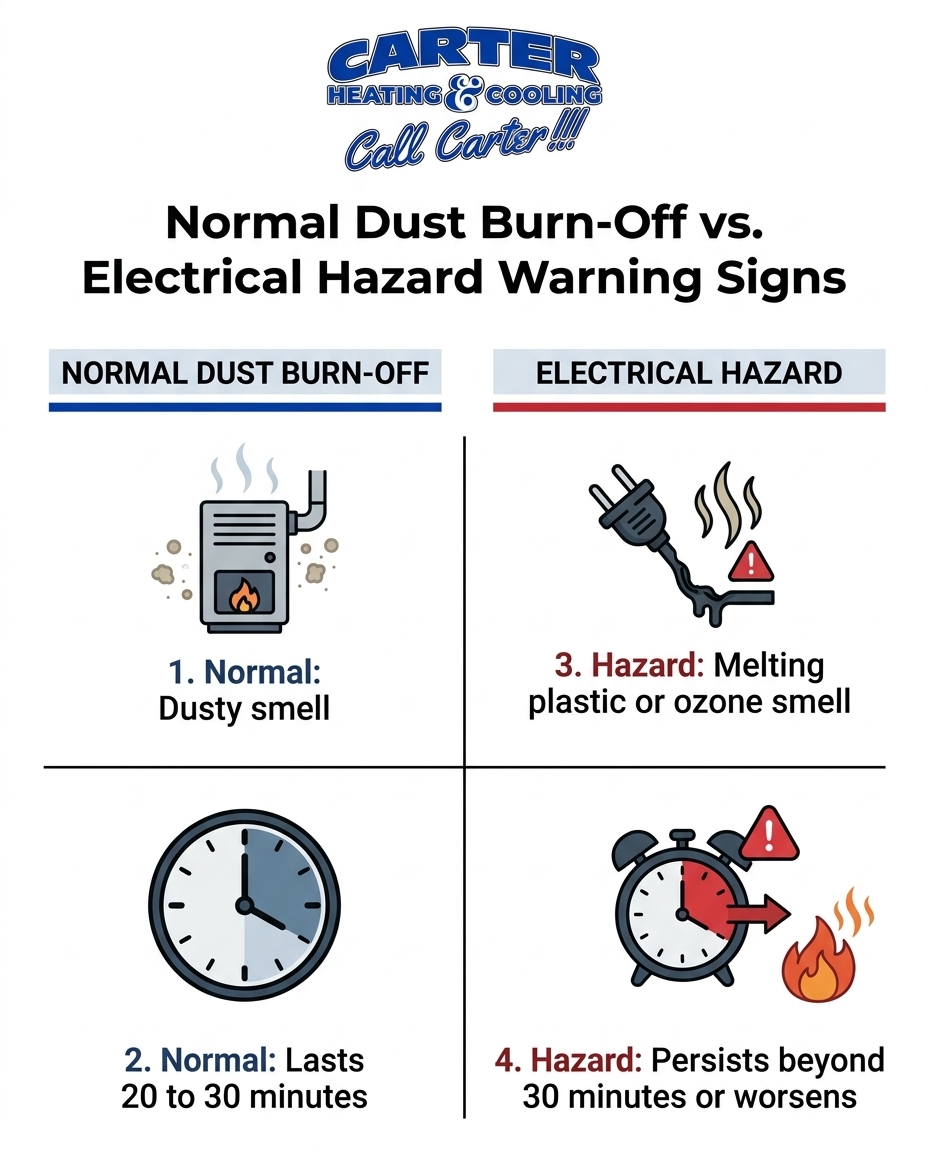
A mild, dusty burning smell is completely normal during the first use of the season. However, there is a strict time-bound rule you must follow to ensure your home remains safe. This odor should naturally dissipate within 20 to 30 minutes of normal dust burn-off time. If the smell lasts longer than this window, it is no longer just harmless dust. To manage this initial burn-off safely, follow these specific parameters:
1. Note the exact start time: Look at the clock the moment you turn the thermostat to heating mode. You need an accurate baseline to track the 20 to 30-minute window.
2. Ventilate the immediate area: Open a few windows and turn on ceiling fans to help clear the initial wave of incinerated dust from your living spaces.
3. Monitor the vent output: Stand near a supply register and pay attention to the nature of the smell. It should smell like hot, dry dust—not chemicals or plastic.
4. Watch for smoke: While a smell is normal, visible smoke billowing from your vents or the furnace cabinet is never normal and requires immediate shutdown.
You might wonder how dust gets into the furnace if it hasn't been running. Even when your system is only providing cooling during the summer, the indoor blower motor constantly pulls air through the return ducts and pushes it past the dormant heat exchanger. While your air filter catches the vast majority of debris, microscopic particles inevitably slip through and settle on the cold metal surfaces. After months of accumulation, this creates a thin layer of organic material that simply must burn away when the heat kicks on.
If the smell persists beyond the 20 to 30 minutes of normal dust burn-off time, or if it gets progressively worse as the system runs, you are not dealing with standard household dust. You are likely smelling an active electrical failure. It is crucial to contrast normal dust burn-off with dangerous electrical odors so you can categorize the smell accurately and take the appropriate action.
The distinct smell of an electrical failure is sharp and unnatural. It often resembles melting plastic, burning rubber, a sharp acrid wire odor, or a metallic scent known as ozone. These odors indicate that internal components are actively overheating and melting their protective casings. Common failing components include melted wire harnesses, struggling blower motors, or short-circuiting control boards. When you detect these specific odors, you must immediately shut off the system at the thermostat.
• Scent Profile — Normal Dust Burn-Off: Dry, earthy, similar to a hot radiator or old vacuum cleaner. — Dangerous Electrical Failure: Sharp, chemical, melting plastic, burning rubber, or metallic ozone.
• Duration — Normal Dust Burn-Off: Fades away completely within 20 to 30 minutes. — Dangerous Electrical Failure: Persists beyond 30 minutes and often grows stronger over time.
• Physical Reaction — Normal Dust Burn-Off: Mildly unpleasant but generally tolerable. — Dangerous Electrical Failure: Acrid enough to cause coughing, watery eyes, or throat irritation.
• Visible Signs — Normal Dust Burn-Off: None. Air remains clear. — Dangerous Electrical Failure: May be accompanied by faint smoke near the unit or flickering lights.
• Required Action — Normal Dust Burn-Off: Keep system running, open windows, and monitor the time. — Dangerous Electrical Failure: Shut off the thermostat immediately and call for emergency service.
One of the most concerning scents associated with an electrical failure is ozone. It smells somewhat like the air right after a severe lightning storm—clean, metallic, and slightly sweet, but harsh on the lungs. This smell is produced when high-voltage electrical arcing occurs across a failing relay or a cracked circuit board. If you smell ozone near your furnace, it means electricity is jumping where it shouldn't be, creating a massive fire hazard.
You might be asking yourself how a furnace develops an electrical problem during the months it isn't even turned on. The answer lies in the severe weather events and grid fluctuations that occur during the cooling season. These events cause power surges and brownouts that severely stress your HVAC equipment, leaving behind hidden damage that only reveals itself later.
With hot, humid summers and frequent severe thunderstorms sweeping through Bowling Green, local power grids are constantly tested. These storms bring lightning strikes, downed branches, and sudden grid shifts, causing power surges that strike your home's electrical panel. Modern HVAC control boards, variable-speed compressors, and capacitors are highly sensitive to these voltage spikes. Even a minor surge can degrade electrical insulation, while repeated voltage drops (brownouts) force motors to draw excessive amperage, overheating their internal windings.
This type of extreme weather can cause sudden, catastrophic system failures that require immediate intervention. For example, our technicians at Carter Heating & Cooling recently helped a local homeowner whose system broke down right after a severe thunderstorm. Because the situation was critical, we arrived promptly, identified the fried electrical components caused by the grid fluctuations, and restored their comfort right away. While that particular system failed immediately, a pattern we see often in Bowling Green is systems sustaining partial, hidden damage that lingers quietly in the background.
This hidden electrical stress is frequently related to why your AC coil froze during peak summer humidity, as compromised electrical components fail to maintain the proper fan speeds and refrigerant cycles needed to keep the system balanced.
If a summer storm damaged your system's electrical integrity, why does the burning smell only appear in the fall? The reality is that compromised electrical components may continue to limp along during the final, milder weeks of summer cooling. The damage is present, but the specific relays, sequencers, and circuits dedicated exclusively to the heating cycle remain dormant and untested.
Switching your thermostat from cooling to heating introduces entirely new electrical loads to the system. It activates gas valves, electronic igniters, heat sequencers, and entirely different speed taps on your blower motor. The sudden demand of this first heating cycle acts as a rigorous, unavoidable stress test for the entire electrical cabinet.
When those crisp October temperature drops hit Bowling Green, and you finally call for heat, the weakened components are pushed past their breaking point. A relay that sustained minor surge damage in July might finally fuse shut in October. A wire with degraded insulation might finally arc against the metal casing. This delayed reaction is exactly why electrical burning smells frequently coincide with the very first major temperature drop of the season.
In many heating systems, particularly heat pumps and electric furnaces, a component called a heat sequencer manages the electrical load. Instead of turning on all the heating elements at once—which would instantly trip your circuit breaker—the sequencer turns them on one by one in a staggered series. If a summer power surge damaged the sequencer's internal timing mechanisms, it might attempt to pull too much power at once during the October initial heating startup, resulting in melting wires and a strong plastic burning smell.
When facing a persistent burning smell, safety must be your top priority. While you should never attempt to repair an electrical fault yourself, there are a few safe, actionable troubleshooting steps you can take to rule out simple airflow issues before calling a professional.
1. Check and replace clogged air filters: A severely restricted air filter chokes the blower motor. Without adequate airflow, the heat exchanger cannot dissipate its heat properly. This causes the entire system to overheat, baking the surrounding dust and producing a strong burning odor. Always start by installing a fresh, clean filter.
2. Verify thermostat settings: Ensure the system is actually set to heating mode and that the temperature setpoint is reasonable. A malfunctioning thermostat can cause the system to short-cycle rapidly, which puts immense electrical strain on the starting components and can lead to overheating.
3. Monitor the system from a safe distance: Watch the clock to see if the odor resolves within the 20 to 30 minutes of normal dust burn-off time. Keep your distance from the physical unit while monitoring the smell at the vents.
Crucial Safety Warning: Never open the furnace cabinet to inspect electrical boards, capacitors, or wiring yourself. Modern HVAC systems operate on high-voltage electricity that can be lethal. Diagnosing internal components carries a severe risk of electrocution and must be handled exclusively by a licensed professional.
Staying diligent with preventative AC maintenance throughout the year ensures that your filters are clean, your airflow is optimized, and any minor electrical wear and tear is caught before it evolves into a dangerous fall breakdown.
If an electrical burning smell persists beyond the initial burn-off window, or if it smells distinctly of melting plastic or ozone, you must turn off the system immediately. Switch the thermostat to the "Off" position and do not turn it back on to see if the smell improves. Continuing to run a compromised system drastically increases the risk of an electrical fire and guarantees further destruction of expensive internal equipment.
Diagnosing power quality damage is a complex process. It requires specialized multimeters and testing tools to check incoming voltage, test capacitor microfarads, and safely evaluate the integrity of the control boards. A licensed technician can isolate the exact point of failure without putting your home at risk.
Heating failures rarely happen on a convenient schedule. They often occur at the worst possible times, such as the middle of a freezing night, requiring immediate professional dispatch. Having access to 24/7 emergency service ensures that you never have to choose between enduring a freezing house and running a potentially dangerous furnace.
Our emergency dispatch team frequently responds to this exact terrifying scenario. Just last season, a Bowling Green family called us when their furnace stopped working and started emitting an ozone smell in the middle of a freezing night. Because we offer emergency support around the clock, our technician was dispatched immediately. We diagnosed the failing sequencer within five minutes of arrival, replaced the hazardous component, and had the home safely heated again within an hour. Fast, professional diagnostics isolate the electrical issue before it destroys your entire HVAC system, keeping your family safe and warm.
Dealing with a burning smell from your vents can be stressful, but knowing exactly what to look for makes all the difference. While brief dust odors are perfectly normal during the first fall startup, persistent electrical smells require immediate professional attention. Never ignore a scent that resembles melting plastic, burning rubber, or ozone.
Prioritize your family's safety this season. If you suspect that severe summer storms and power surges caused hidden damage to your equipment, or if your system fails to clear the 20 to 30 minutes of normal dust burn-off time, have your heating system inspected by a qualified technician. Addressing these warning signs early prevents major breakdowns, mitigates fire hazards, and ensures your home stays warm, safe, and comfortable all winter long.
How long should a furnace smell like burning when first turned on?
It should only smell for 20 to 30 minutes. This brief window allows settled summer dust and airborne particles to safely burn off the heat exchanger. If the smell lasts longer than half an hour, or if it grows stronger, you should shut the system down and call for a professional inspection.
What does an electrical failure in a furnace smell like?
An electrical failure typically smells like melting plastic, burning rubber, or a sharp, metallic ozone scent. Unlike the mild, earthy smell of normal dust burn-off, an electrical odor is highly acrid, unnatural, and may even irritate your eyes or throat if you stand near a vent.
Can a power surge damage my HVAC system?
Yes, power surges and brownouts can severely damage sensitive HVAC components. The sudden spike in electrical voltage degrades wire insulation, fries modern control boards, and weakens capacitors, frequently leading to delayed system failures that only become apparent when the seasons change.
Is it safe to run my heater if it smells like burning plastic?
No, it is never safe to run your heater if you smell burning plastic. This specific odor strongly indicates that internal wires, relays, or circuit boards are actively melting. This poses a severe fire hazard and requires you to turn off the system immediately until a professional can repair it.
How do I know if my AC broke down due to poor power quality?
Signs of power quality damage include frequently tripped circuit breakers, humming noises from the condenser, or a system that fails immediately after a severe thunderstorm. A licensed technician uses specialized multimeters to test your capacitors and control boards to confirm if voltage spikes caused the breakdown.
Hear from your neighbors to see how our commitment to dependable service and lasting comfort has made a difference in their homes.

Ready to Transform Your Home?
Discover our exceptional home services tailored to meet your need and enhance your living space.
What that burning smell actually means for your HVAC. Use these home maintenance tips and troubleshooting to decide whether to wait or schedule service today.
Smelling burning dust or facing a startup delay? See what triggers this safety pause and how home maintenance tips and troubleshooting keep your system safe.
Did a routine fall maintenance visit turn into a high-pressure sales pitch? Discover how corporate overhead impacts your estimate and why a local second opinion matters.