

Heating Options Comparisons for Homeowners: Heat Pumps vs. Gas Furnaces
Trying to make sense of heating options comparisons for homeowners before freezing weather hits? Compare your options between heat pumps and gas furnaces.
Read More

How can we help today?
Choose an option to see quick actions and get help faster.Heating Options Comparisons for Homeowners: Heat Pumps vs. Gas Furnaces
Trying to make sense of heating options comparisons for homeowners before freezing weather hits? Compare your options between heat pumps and gas furnaces.
Are you trying to make sense of the many heating options comparisons for homeowners as the temperatures start to drop? If your current system struggled through the end of last winter, you are likely wondering if it is truly prepared for the upcoming seasonal transition. Here at Carter Heating & Cooling, we know that November acts as a critical transition month for late fall and pre-winter readiness, making it the ideal time to evaluate your home's heating infrastructure before peak demands strain aging equipment.
Whether you are looking to upgrade your air conditioning systems alongside your heating or you simply want to avoid a late-season call for AC repair in Bowling Green during an unseasonable warm spell, exploring these choices with our experienced team now is the smartest move you can make.
The primary decision point usually comes down to weighing the high, long-term efficiency of modern electric heat pumps against the raw, immediate heating power of traditional gas furnaces. In our years serving local families, we have seen that aging units, regardless of their fuel type, frequently show signs of mechanical failure during these harsh seasonal shifts. By addressing your heating needs early, you prevent the stress of a sudden furnace failure in a deep freeze.
To make an informed decision, it helps to understand exactly how these two distinct technologies warm your home. While our comprehensive heating system services cover both types of equipment, the fundamental operation of a heat pump is entirely different from that of a gas furnace. As our technicians often explain, the distinction comes down to heat generation versus heat transfer.
Gas furnaces generate heat through combustion. They burn natural gas in a sealed chamber, which heats up a metal component called a heat exchanger. Your blower motor then forces indoor air over this hot metal, rapidly warming the air before pushing it through your ductwork. Because it relies on fire, a gas furnace delivers air at a very high temperature right out of the register.
Heat pumps, on the other hand, do not burn fuel to create heat. Instead, they use electricity and advanced refrigerants to absorb ambient heat from the outside air and transfer it inside your home. Even when it feels cold outside, there is still thermal energy in the air. A heat pump acts like a sponge, soaking up that outdoor heat, compressing it to make it hotter, and releasing it indoors.
When comparing the two, you will notice different efficiency ratings. Furnaces use AFUE (Annual Fuel Utilization Efficiency), which measures the percentage of fuel converted directly into usable heat. Heat pumps use HSPF (Heating Seasonal Performance Factor), which measures the total space heating required during the season divided by the total electrical energy consumed.
• Heating Method — Gas Furnace: Combusts natural gas to generate heat — Electric Heat Pump: Uses electricity to transfer ambient heat
• Air Temperature at Register — Gas Furnace: Very high (often 120°F - 140°F) — Electric Heat Pump: Moderate and consistent (around 95°F - 105°F)
• Efficiency Rating Metric — Gas Furnace: AFUE (Annual Fuel Utilization Efficiency) — Electric Heat Pump: HSPF (Heating Seasonal Performance Factor)
• Primary Energy Source — Gas Furnace: Natural Gas — Electric Heat Pump: Electricity
Your home's existing infrastructure plays a massive role in which system makes the most sense. If your home does not already have an established natural gas line, our installation team will need to evaluate the feasibility of running new gas piping, which complicates the installation process. Conversely, upgrading to a high-capacity heat pump might require an evaluation of your electrical panel to ensure it can handle the dedicated circuits required by modern air handlers and outdoor compressors.
Under normal seasonal stress, we see both equipment types offer excellent longevity when properly maintained. Gas furnaces typically last slightly longer—often 15 to 20 years—because they only run during the winter months. Heat pumps operate year-round, handling both your summer cooling and winter heating, which means they endure more wear and tear, typically lasting 12 to 15 years in Bowling Green KY.
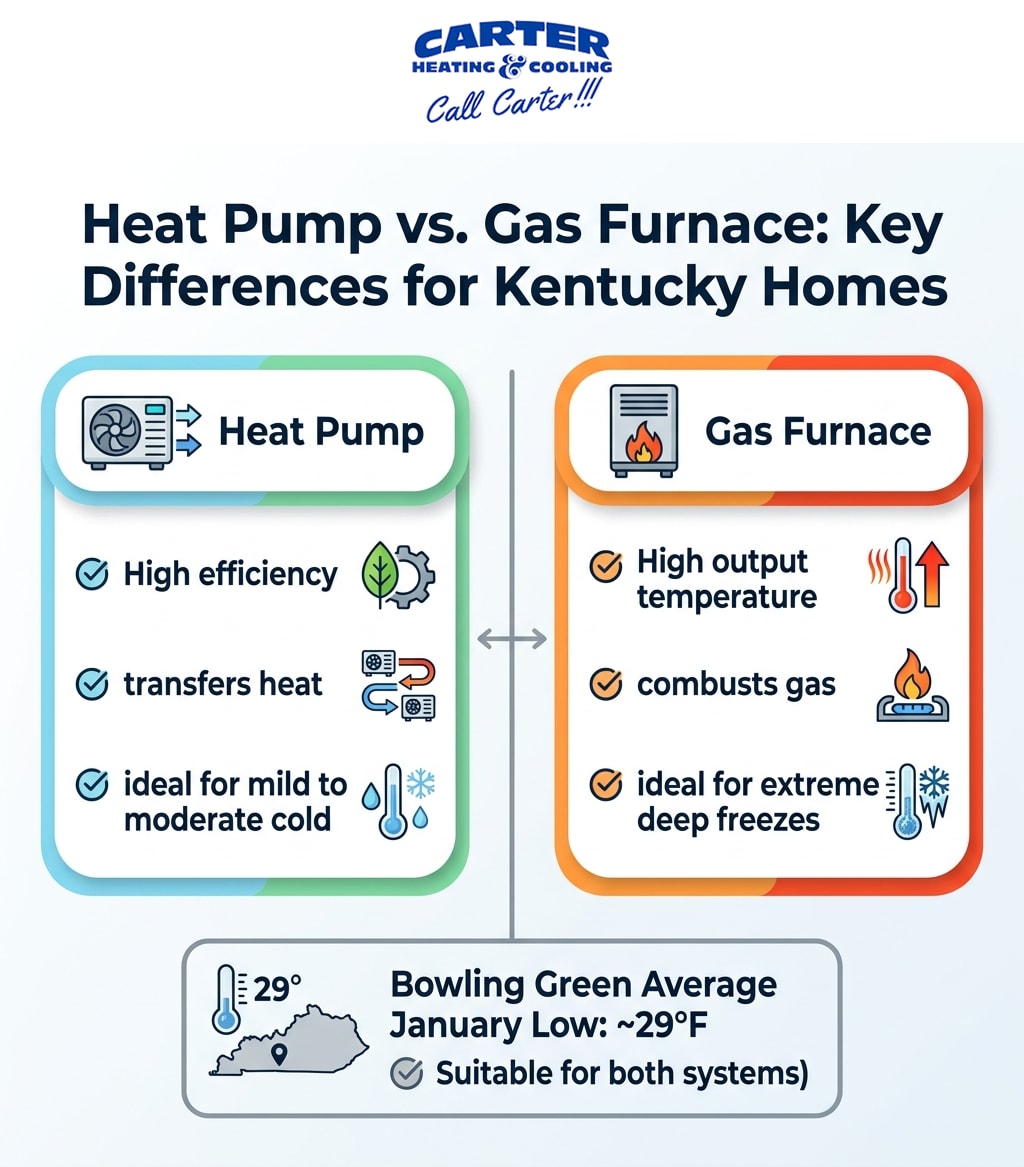
Generic national heating advice often fails to account for the unique weather patterns we experience locally. At Carter Heating & Cooling, we know that Bowling Green KY features a highly variable winter climate. We experience a mix of mild fall weather, rainy winter afternoons, and sudden, biting deep freezes. The average January low hovers right around 29 degrees Fahrenheit.
This specific temperature range is critical because it places our region squarely in the operational "sweet spot" where both heat pumps and gas furnaces are highly viable options. For decades, a persistent myth suggested that heat pumps could not handle southern winters once the temperature dropped below freezing. While that may have been true for units built in the 1990s, modern cold-climate heat pumps are engineered with advanced variable-speed compressors that operate efficiently well below freezing.
One local homeowner we recently worked with experienced the drawbacks of outdated technology firsthand when their failing, older heat pump caused poor airflow and recurring mechanical problems over several years. After our technicians performed an assessment that revealed code compliance issues with the aging setup, we provided them with a detailed explanation of their upgrade options. By replacing the old, non-code-compliant unit with a modern, high-efficiency system, they significantly improved their home's airflow, restored reliable heating, and took advantage of generic utility rebates available for the upgrade.
When you align your equipment choice with the reality of our local climate, you ensure that your home stays comfortable during a 50-degree November afternoon just as easily as it does during a 15-degree January night.
For homeowners prioritizing long-term energy efficiency, our team frequently points out the distinct advantage of heat pumps. Because they move heat rather than creating it from scratch, they can deliver up to three times more heat energy to a home than the electrical energy they consume. This makes them incredibly efficient during late fall and pre-winter readiness periods when the outdoor temperatures are chilly but not freezing.
Heat pumps also provide a more consistent, even temperature profile. Instead of blasting your home with intense heat and then shutting off—which creates noticeable temperature swings—a variable-speed heat pump runs at lower speeds for longer periods. This constant circulation eliminates cold spots and keeps the indoor climate perfectly balanced.
Additionally, because heat pumps are highly efficient electric appliances, they are frequently the target of energy incentives. Generic federal tax credits and local utility rebates may apply to qualifying high-efficiency heat pump installations. You should always verify current programs with your utility provider or a tax professional to see how these incentives might offset your initial installation costs.
Pros of Heat Pumps:
• Unmatched efficiency: Transfers heat instead of burning fuel, dramatically lowering energy consumption in mild weather.
• All-in-one comfort: Provides both heating in the winter and cooling in the summer from a single system.
• Even heating: Runs longer cycles at lower speeds to prevent drastic temperature fluctuations.
• Incentive eligibility: Often qualifies for generic energy rebates and tax credits.
Cons of Heat Pumps:
• Lower register temperatures: The air blowing from the vents feels warm, but not "hot" like a furnace, which takes getting used to.
• Defrost cycles: The outdoor unit will occasionally pause heating to melt frost buildup during freezing rain or snow.
• Year-round wear: Because it operates 365 days a year, it requires diligent bi-annual maintenance.
While heat pumps win on mild-weather efficiency, our technicians know that gas furnaces remain the undisputed champions of raw heating power. When a sudden arctic front pushes temperatures down into the single digits, a gas furnace does not have to work harder to find heat in the freezing air—it simply burns natural gas to generate intense, immediate warmth.
Many homeowners we serve in Bowling Green KY prefer the higher output air temperature that a gas furnace delivers. The air coming out of your vents from a furnace is typically between 120°F and 140°F. This provides a rapid, cozy heating experience that quickly warms up a freezing house after you have been away for the weekend.
If your home already has established natural gas infrastructure, sticking with a gas furnace is often a straightforward and highly reliable choice. You do not have to worry about upgrading your electrical panel, and you gain unwavering performance during the most extreme, uncharacteristic cold snaps our region occasionally faces.
Pros of Gas Furnaces:
• Rapid heating: High output temperatures warm up the home much faster than electric alternatives.
• Extreme cold reliability: Performance does not drop off, regardless of how cold it gets outside.
• Longer lifespan: Because they only operate during the winter months, the internal components experience less annual wear.
• Familiar comfort: Delivers the intensely hot air from the registers that many homeowners are accustomed to.
Cons of Gas Furnaces:
• Combustion risks: Requires proper venting and functioning carbon monoxide detectors to ensure safe operation.
• Dry air: The intense heat can dry out the indoor air, sometimes requiring a whole-home humidifier.
• Fossil fuel reliance: Ties your winter heating costs directly to fluctuating natural gas prices.
If you find yourself torn between the efficiency of a heat pump and the raw power of a gas furnace, our experts at Carter Heating & Cooling often recommend a third option that offers the best of both worlds: the hybrid, or dual-fuel, system. A hybrid system pairs an electric heat pump with a gas furnace, using smart thermostat technology to automatically switch between the two based on the outside temperature.
During late fall and pre-winter readiness months, the system relies on the electric heat pump. Because the weather is only moderately cold, the heat pump operates at peak efficiency, transferring ambient heat indoors and keeping your energy consumption low. However, once the temperature drops past a specific "balance point"—usually around 35°F or 40°F—the system automatically shuts down the heat pump and ignites the gas furnace.
This automatic switching provides the ultimate peace of mind during seasonal transitions. You get the cost-saving efficiency of electric heating for 70% of the winter, and the unstoppable, rapid heating power of gas for the 30% of the winter when it is freezing outside.
It is important to note that hybrid setups are mechanically complex. Because you are essentially operating two completely different heating technologies in tandem, consistent upkeep is non-negotiable. Scheduling preventative AC maintenance for the heat pump side and dedicated tune-ups for the furnace side ensures that the system switches fuels seamlessly when the weather turns.
Even the most carefully chosen, top-of-the-line heating system can experience sudden mechanical or electrical failures. Power quality issues, power surges, and severe weather events place immense stress on HVAC components. Just as extreme summer heat can cause unexpected breakdowns—similar to why your AC coil froze during August humidity—extreme winter weather can push a furnace or heat pump past its limits. HVAC stress is a year-round reality in Bowling Green KY.
During a period when families were spending more time indoors, our dispatch team received an urgent call from a local household whose air conditioning system failed unexpectedly, leaving them incredibly uncomfortable. One of our technicians arrived promptly, diagnosed the issue, explained the technical problem in easy-to-understand terms, and completely repaired the system to get things fully operational again. That level of clear communication and rapid response is just as critical in the dead of winter.
When the temperature is 15 degrees outside and your heat stops working at 2:00 AM, you need 24-hour emergency repair readiness to provide immediate peace of mind. Having access to a local team like ours that can quickly process warranty work, source replacement parts, and restore your heat in the middle of a freezing night is invaluable.
Ultimately, getting objective, neutral guidance from our experienced installers during the installation process leads to fewer emergency calls down the road. When a system is properly sized and matched to your home's specific ductwork and insulation profile, it operates smoothly, reducing the likelihood of sudden winter breakdowns.
Neither system is universally "better"; it depends entirely on your home's infrastructure and your comfort preferences. Heat pumps are highly efficient for Bowling Green's moderate winter days and provide both heating and cooling in one unit. However, gas furnaces offer faster, hotter air delivery during our occasional deep freezes. A professional assessment from our team can determine which is better for your specific property.
Older heat pumps typically began losing efficiency around 35°F to 40°F. However, modern cold-climate heat pumps are engineered to operate efficiently at temperatures down to 5°F or even lower. While they do consume more electricity as the temperature drops toward freezing, they remain a highly viable and efficient heating source for the vast majority of Kentucky's winter days.
You do not strictly need a gas furnace if you have a heat pump. Most standalone heat pumps are paired with an electric air handler that contains supplemental electric resistance heating strips. These strips automatically turn on to provide extra heat if the outdoor temperature drops too low for the heat pump to keep up. However, if you want the fast-heating benefits of gas, we often install dual-fuel hybrid systems as a perfect compromise.
For extreme, sub-freezing cold weather, in our experience, a gas furnace is generally considered the most reliable and powerful option because it does not rely on extracting heat from the freezing outdoor air. Gas furnaces provide consistent, high-temperature output regardless of outside conditions. That said, properly installed modern heat pumps are also highly reliable, provided they are correctly sized for the home.
Utility rebates and generic tax incentives can significantly lower the upfront cost of installing high-efficiency equipment. Because heat pumps are highly efficient electric appliances, they frequently qualify for more substantial incentives than standard gas furnaces. These financial incentives often make upgrading to a premium heat pump or dual-fuel system much more accessible, though you should always verify current local programs before making a decision.
Choosing the right replacement system requires balancing long-term energy efficiency with the specific heating demands of your home. Whether you prioritize the year-round efficiency of a heat pump, the raw winter power of a gas furnace, or the adaptable nature of a hybrid system, late fall and pre-winter readiness is the key to a stress-free season.
Navigating these choices shouldn't be overwhelming. You deserve objective, pressure-free heating options comparisons for homeowners that focus on your comfort, not a sales quota. Take the time to explore your comprehensive heating options today, and reach out to the team at Carter Heating & Cooling for a neutral, expert assessment to ensure your home stays warm and safe all winter long.
Hear from your neighbors to see how our commitment to dependable service and lasting comfort has made a difference in their homes.

Ready to Transform Your Home?
Discover our exceptional home services tailored to meet your need and enhance your living space.
Trying to make sense of heating options comparisons for homeowners before freezing weather hits? Compare your options between heat pumps and gas furnaces.
What that burning smell actually means for your HVAC. Use these home maintenance tips and troubleshooting to decide whether to wait or schedule service today.
Smelling burning dust or facing a startup delay? See what triggers this safety pause and how home maintenance tips and troubleshooting keep your system safe.