Choosing Between a Whole-House Humidifier and Portable Units for Kentucky Winters
Choosing Between a Whole-House Humidifier and Portable Units for Kentucky Winters
When the November freeze hits, fighting dry air shouldn't mean endless water refills. Explore the hidden time costs of portable humidifiers and see if a whole-home system is right for you.
The November Humidifier Routine: Is There a Better Way to Beat Dry Air?
Before the first major freeze hits, there is one familiar household chore that signals the start of the season. Choosing Between a Whole-House Humidifier and Portable Units for Kentucky Winters is a common dilemma for homeowners who wake up with dry skin, static shocks, and scratchy throats as soon as the furnace kicks on. The November late fall heating onset brings a sudden, noticeable drop in indoor relative humidity across Kentucky, forcing residents to take immediate action to stay comfortable.
For many, this seasonal shift means hauling dusty portable humidifiers out of the attic or garage, scrubbing away last year's hard water scale, and resigning themselves to months of daily refilling. It is a frustrating cycle. You want the comfort of properly moisturized air, but the daily hassle quickly becomes a dreaded chore. The core decision you face is whether to continue managing these small units room-by-room or to finally upgrade to an integrated, whole-home solution that operates automatically.
If you are tired of the daily water-hauling routine, exploring your options with professional HVAC services can point you toward a permanent fix that saves time and improves your family's quality of life.
The Hidden Time Cost and 'Chore Fatigue' of Portable Humidifiers
When the temperature drops, your furnace works overtime. Frequent temperature drops below freezing in Bowling Green, KY force home heating systems to run constantly. Our technicians at Carter Heating & Cooling see this firsthand every November: because cold air holds very little moisture, heating that air drastically lowers its relative humidity. This strips moisture from your home's interior much faster than small room humidifiers can replace it.
The Square Footage Limitation
One of the biggest drawbacks of portable humidifiers is their limited reach. Most standard bedroom units are only designed to cover 200 to 400 square feet. In an average-sized home, relying on portable units means you need one in the primary bedroom, one in each child's room, and at least one large console unit for the main living area. This fragmented approach creates uneven humidity zones. You might have a comfortable bedroom but walk out into a bone-dry hallway or living room, experiencing a sudden shift in air quality that irritates your sinuses.
The Daily Refill and Cleaning Grind
Managing multiple portable units introduces a significant physical burden known as "chore fatigue." In our years serving local homeowners, we have found this daily grind is the number one reason families finally upgrade. Consider the actual weight of the water you are moving. A single gallon of water weighs over eight pounds. If you have three or four humidifiers that need filling every single day, you are hauling twenty to thirty pounds of water from your sink or bathtub to various rooms nightly.
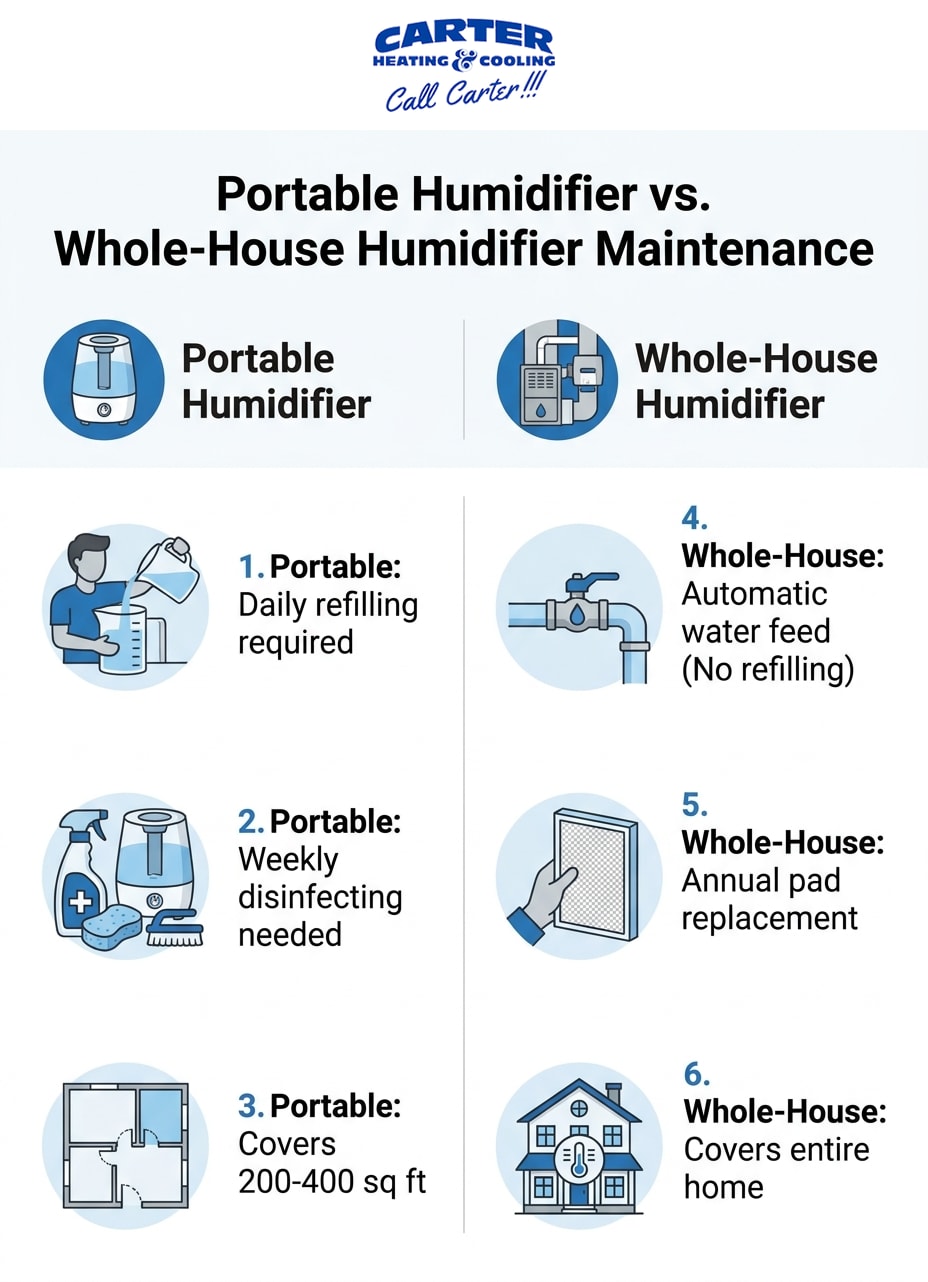
1. Daily Refilling: Unplugging units, carrying heavy tanks, avoiding spills on hardwood floors, and carefully realigning the tank on the base.
2. Weekly Disinfecting: Portable units are notorious breeding grounds for mold and bacteria if left unchecked. You must empty them, soak the components in white vinegar or a bleach solution, and scrub tight corners with a small brush to prevent pink mold and slime from forming.
3. Filter Maintenance: Evaporative portable models require frequent wick filter replacements, often every 30 to 60 days, adding an ongoing maintenance task to your calendar.
The White Dust Dilemma
If you use an ultrasonic portable humidifier without distilled water, you will likely encounter the "white dust" phenomenon. Ultrasonic units vibrate water into a fine mist, which includes all the dissolved minerals found in your tap water. When the mist evaporates, those minerals settle on your furniture, electronics, and floors as a fine, chalky white dust. Our service team frequently visits homes where this mineral dust has coated expensive electronics, making constant purchases of distilled water a necessary but inconvenient part of the winter routine.
There is a stark contrast between manually managing indoor air quality and letting your home's infrastructure do the heavy lifting. At Carter Heating & Cooling, we regularly speak with homeowners who are completely frustrated by their winter chores. Over our years of installing indoor air quality systems, we have found that integrated, whole-house systems offer the permanent, set-it-and-forget-it comfort our customers crave. Instead of treating just a few rooms, a whole-house humidifier treats every cubic foot of air that passes through your ductwork.
Direct Plumbing Integration
The most significant lifestyle improvement of a whole-house system is the elimination of the daily refill. These units are plumbed directly into your home's existing water supply. When the system calls for humidity, a solenoid valve opens automatically, allowing fresh water to flow over a water panel or evaporator pad. There are no tanks to carry, no spills to wipe up, and no heavy lifting required. The system draws exactly what it needs and drains away any excess, ensuring that the water is always fresh and never stagnant.
Automated Climate Control
Modern whole-house humidifiers are controlled by a humidistat, which functions much like your thermostat but measures moisture instead of temperature. Once you set your desired humidity level, the system monitors the air automatically. When the November late fall heating onset arrives and the air dries out, the humidistat communicates with your furnace blower to distribute moisture. Some advanced models even feature outdoor temperature sensors that automatically lower the indoor humidity setpoint when the weather gets extremely cold, preventing condensation from forming on your windows.
Even Distribution Across All Rooms
Because the humidifier is mounted directly to your HVAC system's supply or return plenum, the moisture is introduced into the conditioned air before it is distributed throughout the house. This means every room with a supply register receives the exact same level of comfortable, moisturized air. There are no dry zones in the hallways or overly damp corners in the bedrooms—just consistent, balanced comfort everywhere you walk.
Side-by-Side Comparison: Maintenance and Upkeep Requirements
To truly understand the difference between these two approaches, it helps to look at the ongoing effort required to maintain them. While portable units might seem simpler at first glance, our team typically sees their long-term maintenance demands become overwhelming for homeowners.
• Water Refilling — Portable Humidifiers (Multiple Units): Daily (often heavy lifting required) — Whole-House Humidifier System: Never (plumbed directly into water line)
• Deep Cleaning — Portable Humidifiers (Multiple Units): Weekly scrubbing with vinegar/bleach — Whole-House Humidifier System: None required during the heating season
• Filter/Pad Changes — Portable Humidifiers (Multiple Units): Every 1-2 months per unit — Whole-House Humidifier System: Once annually (usually in the fall)
• Coverage Area — Portable Humidifiers (Multiple Units): 200 - 400 sq. ft. per unit — Whole-House Humidifier System: Entire home via ductwork
• Mold/Bacteria Risk — Portable Humidifiers (Multiple Units): High if weekly cleaning is skipped — Whole-House Humidifier System: Very low (continuous fresh water flow)
The Maintenance Breakdown:
• Portable Unit Upkeep: If you neglect a portable unit for even a few days, stagnant water can quickly breed harmful bacteria, which the unit will then aerosolize into your breathing space. You must be vigilant about emptying the basin, drying it out, and replacing the wicks.
• Whole-House Upkeep: A whole-house system is remarkably low-maintenance. The primary requirement is changing the water panel (or evaporator pad) once a year. When our team performs standard fall furnace tune-ups for homeowners in Bowling Green, KY, we typically bundle this simple swap into the service, meaning you don't even have to think about it. The system uses continuous fresh water, so there is no reservoir of standing water to harbor mold.
Portable Humidifier vs. Whole-House Humidifier Maintenance
Health, Comfort, and Indoor Air Quality Standards
Humidification is not just about avoiding static shocks; it is a critical component of your home's overall indoor air quality. The Environmental Protection Agency (EPA) recommends keeping indoor relative humidity between 30% and 50%. Maintaining this specific range is vital for both your physical health and the structural integrity of your home.
Protecting Your Respiratory Health
When the November late fall heating onset arrives, indoor humidity can easily plummet below 20%. According to organizations like the Mayo Clinic, breathing excessively dry air dries out the mucous membranes in your nose and throat. These membranes are your body's first line of defense against airborne viruses and bacteria. When they are dry and cracked, you are far more susceptible to winter colds, sinus infections, and respiratory irritation. A whole-house system continuously maintains the EPA-recommended moisture levels, keeping your respiratory system hydrated and healthy.
Preserving Hardwood and Furniture
Your home is constructed from hygroscopic materials, meaning wood, drywall, and paper naturally absorb and release moisture depending on the surrounding air. When the air becomes too dry, hardwood floors can shrink and separate, leaving unsightly gaps. Wooden doors may warp, crown molding can crack, and expensive musical instruments like pianos can fall out of tune or suffer permanent damage. Portable humidifiers only protect the items in their immediate vicinity. In our experience servicing local homes, a whole-house humidifier acts as an insurance policy for your entire home's interior, preserving your investments by maintaining a stable environment.
Preventing Over-Humidification
While dry air is harmful, too much moisture is equally dangerous. Portable units, especially those without built-in hygrometers, can easily over-humidify a closed bedroom, pushing localized humidity past 60%. This creates a prime environment for dust mites and window condensation, which can lead to mold growth on window sills. Whole-house systems eliminate this risk through precise, central humidistat control, ensuring the air never reaches dangerous moisture levels.
Evaluating Long-Term Value and Lifestyle Impact
When weighing your options, it is important to look beyond the immediate moment and consider the long-term impact on your lifestyle and your home's infrastructure. Portable units have a lower initial barrier to entry, but they come with a high ongoing time cost and a surprisingly short lifespan. Most portable units need to be replaced every few years due to motor failure or calcification.
The Case for Portable Units:
• Immediate Deployment: You can purchase one and plug it in the same day.
• Renter-Friendly: Ideal if you do not own the home or cannot modify the HVAC system.
• Targeted Use: Useful if you only need temporary humidification for a few days while recovering from a cold.
The Case for Whole-House Systems:
• Zero Daily Chores: Reclaim your evenings by eliminating the water-hauling routine.
• Discreet Operation: No bulky plastic tanks taking up floor space or cluttering your nightstands.
• Whisper-Quiet: The humidification process happens down in your ductwork, so you never hear the gurgling or fan noise associated with room units.
• Increased Home Value: An integrated IAQ system is a permanent upgrade to your home's mechanical infrastructure.
The Energy Efficiency Bonus
There is also a hidden energy benefit to whole-house humidification. Properly humidified air actually feels warmer to the human body than dry air at the exact same temperature. Because moisture slows the evaporation of sweat from your skin, 68 degrees at 45% humidity feels significantly cozier than 72 degrees at 20% humidity. By maintaining optimal moisture levels, you can often lower your thermostat by a few degrees without sacrificing comfort, which reduces the strain on your furnace. Understanding how humidity extremes impact your HVAC system is key to maximizing both comfort and efficiency in Bowling Green, KY. Additionally, energy efficiency upgrades like optimizing your heating system with proper IAQ equipment may even qualify for generic utility incentive programs, though it is always best to consult your local provider for details.
Frequently Asked Questions About Winter Humidification
Are whole house humidifiers worth it?
Yes, for homeowners who want consistent, low-maintenance humidity control across their entire home, our team highly recommends them. They eliminate the daily chores associated with portable units, protect your home's woodwork from cracking, and improve overall respiratory comfort. Because they integrate directly with your HVAC system, they offer a permanent lifestyle upgrade.
How much maintenance does a whole house humidifier need?
Typically, a whole-house system just requires an annual replacement of the water panel or evaporator pad. This is usually performed during your standard fall furnace tune-up. Unlike portable units, there is no daily refilling, no weekly scrubbing with bleach, and no ongoing battle against hard water scale buildup.
Can a portable humidifier do a whole house?
No, most portable humidifiers only cover 200 to 400 square feet and cannot push moisture through walls or ductwork. Even large console-style portable units struggle to distribute moisture evenly across multiple rooms. To properly humidify an entire home, you need a system that introduces moisture directly into the central airflow.
Do whole house humidifiers cause mold?
Not when they are properly installed and maintained. They feature dedicated humidistats to prevent over-humidification, keeping moisture levels safely below the 50% threshold where mold thrives. Furthermore, because they use a continuous flow of fresh water from your plumbing, there is no stagnant water reservoir for bacteria to grow in.
What is the ideal indoor humidity for a Kentucky winter?
In Bowling Green, KY, keeping your indoor humidity between 35% and 45% strikes the perfect balance for comfort. This range is high enough to soothe dry skin and protect hardwood floors, but low enough to prevent excessive condensation from forming on your cold window panes during freezing overnight temperatures.
Ready to Retire Your Portable Humidifiers This Winter?
Transitioning from a fragmented, room-by-room approach to an integrated system changes the way you experience winter in your home. Instead of spending the November late fall heating onset scrubbing plastic tanks and hauling gallons of water, you can simply set your humidistat and enjoy perfectly balanced, comfortable air all season long.
Every home's ductwork and heating setup is unique, but our team at Carter Heating & Cooling knows that a permanent solution is easily attainable. If you are ready to stop fighting dry air and start enjoying effortless comfort, reach out to a local expert to explore custom whole-house indoor air quality solutions designed specifically for your space.
Contact Us
Thank you! Your submission has been received!
Oops! Something went wrong while submitting the form.
Choosing Between a Whole-House Humidifier and Portable Units for Kentucky Winters
When the November freeze hits, fighting dry air shouldn't mean endless water refills. Explore the hidden time costs of portable humidifiers and see if a whole-home system is right for you.
Why Your Two-Story Home in Bowling Green Is Freezing Downstairs But Roasting Upstairs
Wearing a sweater downstairs while your upstairs feels like a sauna? We explain the physics behind this temperature imbalance and the airflow solutions that safely restore comfort.
Heating Options Comparisons for Homeowners: Heat Pumps vs. Gas Furnaces
Trying to make sense of heating options comparisons for homeowners before freezing weather hits? Compare your options between heat pumps and gas furnaces.