
How can we help today?
Choose an option to see quick actions and get help faster.Mini split Installationin Oakland, KY
Mini split Installationin Oakland, KY
Upgrade your Oakland, KY home's comfort with our professional mini split installation. Experience efficient cooling, reduced energy costs, and quick setup. Contact us now!
Eliminate System Failures and Restore Consistent Comfort
Are you dealing with frequent breakdowns, strange noises, and inefficient cooling from your old mini-split system in Oakland, KY? Discover a swift, cost-effective replacement solution that ensures your home stays comfortable year-round without the burden of hefty energy bills. Contact us today to discuss financing options or to schedule your site evaluation.
- Experience quick installation and minimal downtime with our skilled technicians.
- Enjoy enhanced energy efficiency and reduced utility costs with our modern mini-split systems.
- Gain peace of mind with comprehensive warranties and straightforward financing options.
Rest assured with Carter Heating and Cooling, as we provide fully licensed services and extensive warranty protections for every replacement we perform.
Immediate Relief with Swift Mini-Split Replacement
When a ductless system fails, the discomfort is immediate. In a humid subtropical climate where seasons shift drastically between hot, humid summers and cold winters, a functioning mini-split is a necessity, not a luxury. Waiting on parts for an obsolete unit or constantly resetting a tripping breaker disrupts your daily life. A replacement service focuses on removing these obstacles immediately.
The goal of a modern replacement is to transition your home from a state of inefficiency to absolute climate control with zero friction. Unlike a repair, which often serves as a temporary patch on a degrading component, a full system replacement resets the clock on your HVAC reliability. You regain control over humidity levels, temperature precision, and air quality.
For homeowners in Oakland, replacing an aging unit eliminates the unpredictability of older mechanics. Compressors that struggle to cycle and blower wheels that rattle are replaced with inverter-driven technology designed for silence and stability. This process is not just about swapping boxes; it is about analyzing why the previous unit failed—whether due to age, improper sizing, or electrical surges—and ensuring the new installation corrects those historical issues for good.
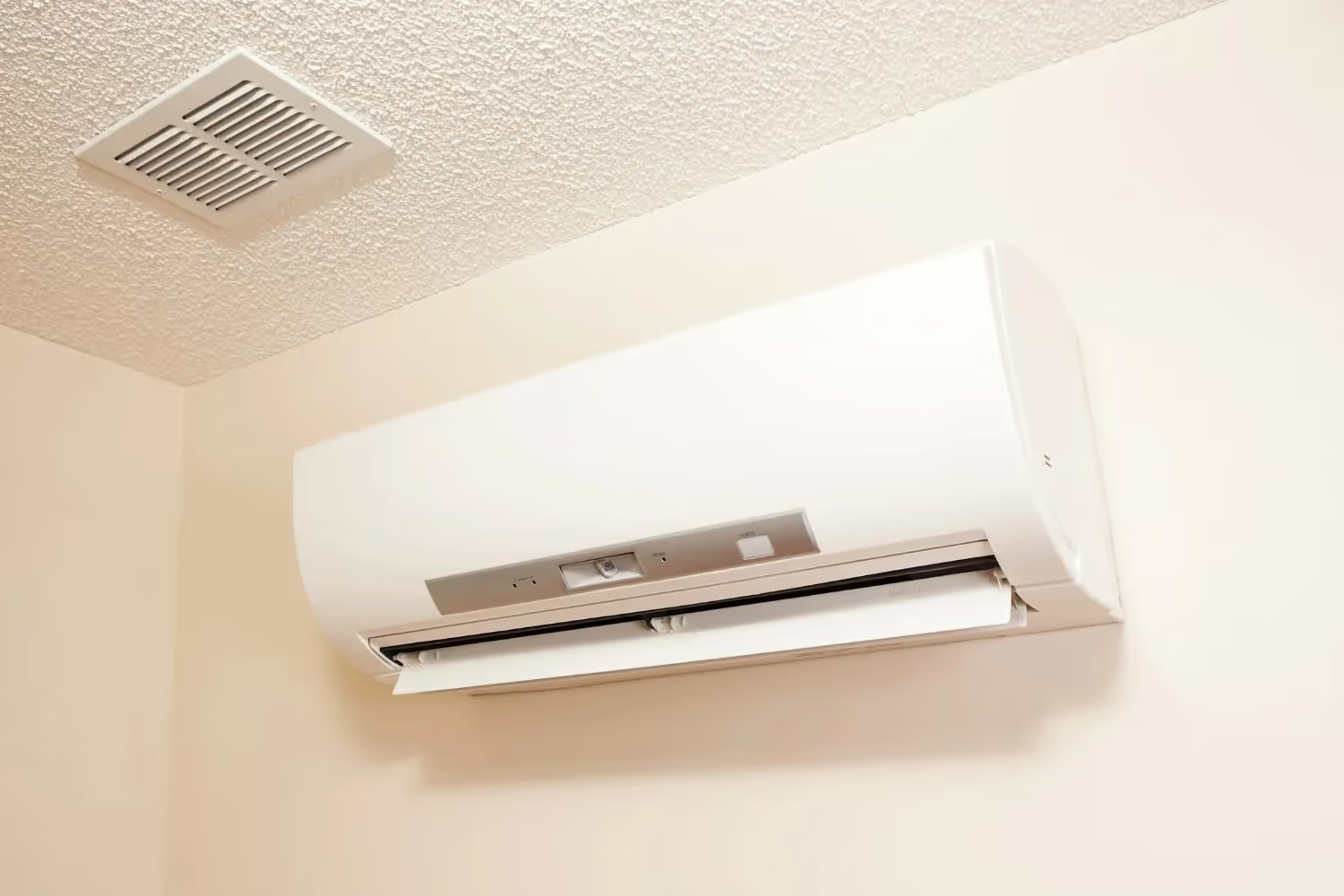
What You Get Today: Performance and Efficiency
Upgrading your ductless system provides immediate tangible benefits that go beyond simple temperature control. Modern manufacturing standards have pushed efficiency ratings (SEER2 and HSPF2) significantly higher than units produced even a decade ago. This means the electricity required to cool or heat a room is drastically reduced, lowering monthly operational costs from the moment the new unit is powered on.
Upon installation, you receive a system capable of modulating its output. Older systems often operated on an all-or-nothing basis—blasting cold air at full speed and then shutting off. The replacement units we install utilize variable-speed compressors. These units ramp up or down gently to maintain the set temperature within a fraction of a degree. This eliminates the uncomfortable "hot and cold" swings often associated with aging equipment.
Additionally, a replacement service includes the proper disposal of your old equipment. Handling refrigerants requires EPA certification and strict adherence to environmental protocols. We handle the recovery of old refrigerant, the removal of the indoor air handler and outdoor condenser, and the cleanup of the installation site. You are left with a clean wall, a quiet outdoor unit, and a remote or thermostat that is intuitive and responsive.
Installation Simplified: The Replacement Process
A professional replacement follows a strict protocol to ensure the longevity of the new investment. This is not a rushed job; it is a calculated engineering process designed to integrate the new system into your existing structure with minimal disruption.
- Site Evaluation and Sizing: The process begins with verifying the load calculation. Insulation levels, window quality, and room dimensions in Oakland homes can change over time. We ensure the new unit’s BTU capacity matches the specific heat load of the space, avoiding short-cycling issues caused by oversized units.
- System Isolation and Removal:
- Power is disconnected at the electrical panel and the outdoor disconnect box to ensure safety.
- Existing refrigerant is pumped down or recovered into certified cylinders to prevent atmospheric venting.
- The old line set, electrical whip, and drain lines are disconnected. The indoor head is carefully unmounted from the wall plate.
- Preparation and Mounting:
- A new mounting plate is leveled and secured to the wall studs. This is critical for proper drainage; a tilted unit can lead to water leaks inside the home.
- If the existing line set is reusable, it is flushed with a specialized cleaning agent to remove old oil and contaminants. If the diameter does not match the new system or if burnout occurred, a new copper line set is run.
- Connections and Flaring:
- The refrigerant lines are connected using precision flaring tools. A poor flare is the leading cause of refrigerant leaks. Torque wrenches are used to tighten connections to the manufacturer's exact specifications.
- Communication wires are connected between the indoor and outdoor units, ensuring the command signals for fan speed and mode are transmitted correctly.
- Pressure Testing and Evacuation:
- The system is pressurized with dry nitrogen to check for leaks at the connection points. This step verifies the integrity of the sealed system before refrigerant is released.
- A vacuum pump is attached to the system to remove moisture and non-condensable gases from the lines. We pull the vacuum down to below 500 microns to ensure a pure, dehydrated environment for the compressor oil.
- Commissioning and Testing:
- The service valves are opened, releasing the refrigerant.
- The system is powered on and tested in both cooling and heating modes.
- Technicians measure the temperature differential (Delta T) between the intake air and the discharge air to confirm the unit is exchanging heat efficiently.
Deciding When Replacement Outweighs Repair
Homeowners often struggle with the decision to repair a failing unit or invest in a replacement. There is a tipping point where pouring money into an old system becomes financially irresponsible. We help you navigate this decision using clear, technical criteria.
- The 50% Rule:
- If the cost of the repair approaches or exceeds 50% of the value of a new system, replacement is the smarter financial move. Major component failures, such as a compressor burnout or a leaking evaporator coil, often fall into this category.
- Refrigerant Type:
- If your current system utilizes R-22 refrigerant, repair is rarely a viable option. R-22 has been phased out due to environmental regulations, making it prohibitively expensive and difficult to source. Modern systems use R-410A or newer low-GWP refrigerants, which are compliant and readily available.
- Frequency of Breakdowns:
- A system that requires attention multiple times a year signals that it has reached the end of its useful life. The cumulative cost of service calls, refrigerant top-offs, and minor part swaps quickly outpaces the monthly financing cost of a new, warrantied unit.
- Age of the Equipment:
- Most mini-split systems have a life expectancy of 12 to 15 years. If your unit is in this age range and performance is declining, efficiency loss is likely costing you money every month. Internal components wear down, causing the unit to draw more amperage to do the same amount of work.
- Part Availability:
- As models become obsolete, manufacturers stop producing control boards and specific fan motors. If sourcing a part takes weeks, replacement is often the only way to restore comfort quickly.
Local Adaptations and Compliance
Operating a heating and cooling system in Oakland, KY requires specific considerations regarding local weather patterns and building codes. The equipment selected must be robust enough to handle high summer humidity and freezing winter lows.
- Humidity Control: Our region experiences significant humidity. A properly sized mini-split acts as a dehumidifier while it cools. If a unit is oversized, it cools the room too quickly and shuts off before it can remove moisture, leaving the room feeling cold and clammy. We prioritize correct sizing to ensure long run times at low speeds, which maximizes moisture removal.
- Low-Ambient Heating: For winter operation, we install systems with low-ambient heating capabilities. Standard heat pumps lose efficiency as the temperature drops. Modern hyper-heating style units can extract heat from the outside air even when temperatures dip well below freezing, ensuring your home stays warm without relying on expensive electric backup strips.
- Condensate Management: Proper drainage is essential to prevent water damage and mold growth. We ensure condensate lines are pitched correctly and, where necessary, install condensate pumps to move water away from the living space. In winter, the outdoor unit produces water as it defrosts; we ensure the unit is mounted on a stand or bracket above the snow line to prevent ice buildup from blocking airflow.
- Electrical and Permit Compliance: Carter Heating and Cooling adheres to all local building codes and National Electric Code (NEC) standards. This includes using the correct gauge wire, installing disconnects within sight of the unit, and ensuring proper circuit breaker sizing to prevent fire hazards. Compliance ensures that your manufacturer warranty remains valid and your home insurance is not compromised.
Why Choose Professional Installation?
The longevity of a mini-split system is almost entirely dependent on the quality of the installation. While the equipment itself is high-tech, it requires precise mechanical skills to operate correctly. A botched installation can lead to refrigerant leaks, electrical shorts, and premature compressor failure.
- Technical Expertise: Our technicians are trained on specific brand protocols. We understand the nuances of inverter boards and electronic expansion valves. We do not guess; we measure, test, and verify.
- Tooling and Equipment: Proper installation requires specialized tools: flaring blocks with clutches to prevent over-tightening, micron gauges for precise vacuum readings, and digital manifolds for accurate pressure testing. We arrive fully equipped to handle any structural challenge your home presents.
- Respect for Property: Installing a ductless unit involves drilling through exterior walls. We take extreme care to seal these penetrations against pests and moisture. We use drop cloths to protect flooring and clean up all debris, including drywall dust and wire clippings, before we leave.
- Warranty Support: A DIY or handyman installation often voids the manufacturer's warranty. By choosing a professional service, you ensure that the equipment is registered and that any future warranty claims will be honored by the manufacturer.
Investing in a replacement mini-split is an investment in the long-term infrastructure of your home. It provides reliable comfort, improved air quality, and predictable energy usage. Whether you are replacing a unit in a sunroom, a garage conversion, or a master bedroom, the focus is always on precision and performance.
Trust Carter Heating and Cooling to handle your mini-split replacement with the urgency and professionalism your home deserves.
Secure Long-Term Comfort Today
Replacing a failing mini-split system is an investment in reliability, energy efficiency, and everyday comfort. Whether the unit serves a bedroom, home addition, garage conversion, or sunroom, the result is quieter operation, lower utility costs, and predictable performance year-round.
Contact Carter Heating and Cooling today to schedule your mini-split replacement consultation and restore consistent comfort to your Oakland home.
Stop overpaying for inefficient cooling. Secure your replacement consultation today.

Great Service at a Fair Price
Veterans Discount


Senior Discount

Law Enforcement

Fire fighters/ems

Hear From Your Neighbors!
Hear from your neighbors to see how our commitment to dependable service and lasting comfort has made a difference in their homes.