
How can we help today?
Choose an option to see quick actions and get help faster.Heating Inspection in Franklin, KY
Heating Inspection in Franklin, KY
Heating Inspection in Franklin, KY
Is Your Furnace Ready for the Cold?
When your heating system fails or operates inefficiently, the discomfort can be unbearable, specifically during the sharp temperature drops common to Franklin’s variable winters. You need a reliable, speedy inspection to ensure your family stays warm and your system operates safely before the coldest nights arrive. Contact us today to schedule your comprehensive heating inspection or inquire about financing options for necessary repairs.
A professional heating inspection is not just a cursory glance at your unit; it is a deep-dive diagnostic aimed at preventing mid-winter breakdowns. Neglecting this maintenance often results in emergency calls when technicians are busiest. Carter Heating and Cooling provides the thorough analysis required to catch small issues before they become expensive failures.
- Same-day service availability ensures you get immediate answers regarding your system's health.
- Trusted local technicians bring deep experience to identify safety hazards like carbon monoxide leaks.
- 24/7 availability means we are ready to respond to your heating needs whenever they arise.
All services are backed by our industry-standard warranties and service guarantees, giving you total peace of mind.
What You Get Today: Comprehensive Heating Inspection Scope
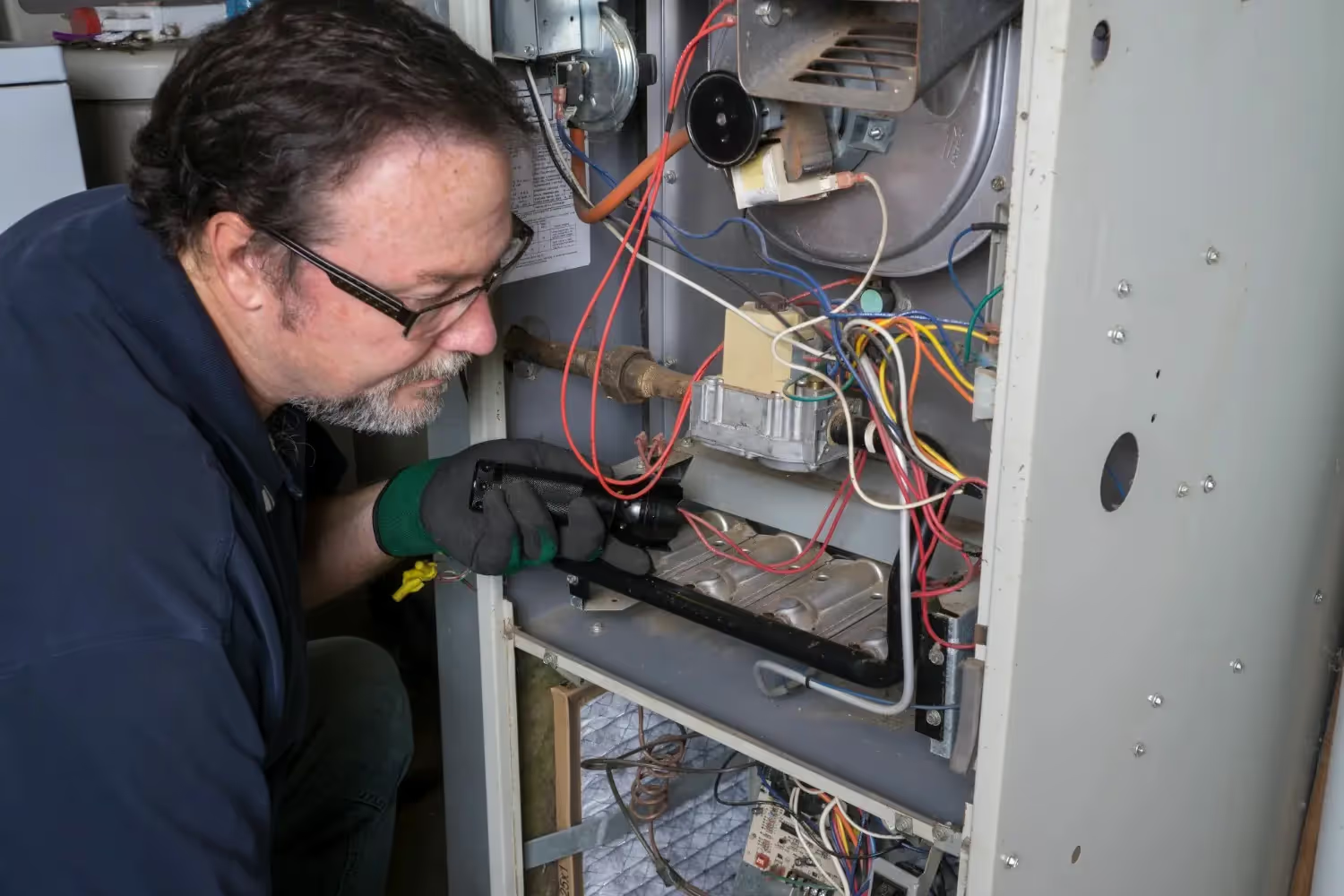
A heating inspection is a rigorous assessment of the mechanical, electrical, and fuel systems within your furnace or heat pump. The objective is to verify that the system is operating within manufacturer specifications and local safety codes. When a technician arrives at your property in Franklin, the focus is on performance data and physical integrity.
The Heat Exchanger Analysis
The heat exchanger is the critical component that separates combustion gases from the air you breathe. Over time, the constant expansion and contraction from heating cycles can cause metal fatigue.
- Technicians visually inspect the heat exchanger for cracks, rust, or separation.
- Specialized cameras may be used to look into hard-to-reach curves of the metal.
- Verification of seal integrity ensures that carbon monoxide is not leaking into the supply air.
Combustion and Ignition Systems
For gas furnaces, the combustion process must be precise to be efficient and safe. Incomplete combustion wastes fuel and creates soot.
- The burner assembly is cleaned and inspected for proper alignment.
- Technicians measure the gas pressure at the manifold to ensure it matches the unit’s rating plate.
- The pilot light or electronic ignition system (hot surface igniter) is tested for reliable startup.
- The flame sensor is cleaned to prevent "false" lockouts where the furnace shuts down believing there is no fire.
Electrical Components and Safety Controls
Electrical failure is a leading cause of heating downtime. Loose connections create heat and can melt wires or destroy boards.
- Capacitors are tested to ensure they are holding the correct microfarad charge; a weak capacitor strains the blower motor.
- All high-voltage and low-voltage wiring connections are tightened.
- Limit switches, which prevent the unit from overheating, are tested for proper operation.
- The thermostat is calibrated to ensure it reads the room temperature accurately.
Blower Motor and Airflow
Without proper airflow, heat cannot be distributed, and the system may overheat.
- The blower wheel is inspected for dust buildup, which creates drag and reduces efficiency.
- Motor amp draw is measured to determine if the motor is working harder than it should.
- The air filter is checked and, if necessary, recommendations are made for replacement type and frequency.
How the Inspection Process Works
Understanding the sequence of a service visit helps you prepare and know what to expect. The process is designed to be non-intrusive while providing a complete picture of your system's condition.
- First, the technician arrives within the scheduled window, prioritizing respect for your property by using shoe covers and floor protectors.
- Next, the technician will ask about any specific concerns you have noticed, such as strange noises, cold spots in the house, or rising utility bills.
- Then, the system is run through a full operational cycle. The thermostat is engaged to call for heat, and the startup sequence is monitored.
- While the system runs, the technician performs the mechanical and electrical checks listed in the scope above, using multimeters, manometers, and gas detectors.
- Afterward, the system is shut down, and the technician inspects static components, such as the flue pipe for obstructions or corrosion.
- Finally, you receive a detailed report outlining the system’s health. This report categorizes findings into urgent safety repairs, recommended performance upgrades, and general observations on system age and condition.
When Replacement Beats Repair
During an inspection, findings may suggest that repairing the current unit is no longer the most improved financial decision. While the goal of maintenance is to extend the life of your heater, certain mechanical failures signal the end of the unit's viable lifespan.
The 50% Rule
A common metric used in the industry is the "50% Rule." If the cost of the necessary repair approaches 50% of the cost of a brand-new system, replacement is generally the wiser investment. A new system resets the warranty clock and offers higher energy efficiency.
The Age Factor
Heating systems generally last between 15 and 20 years. If your furnace is in Franklin and is approaching the 15-year mark, major repairs become less defensible.
- Parts availability becomes scarce for older models.
- Efficiency ratings (AFUE) on older units are significantly lower than modern standards, meaning you are paying more for the same amount of heat.
- The risk of a secondary major failure increases immediately after fixing the first issue on an aged unit.
Safety Violations
Some inspection findings constitute immediate safety hazards.
- A cracked heat exchanger is a non-negotiable failure. Due to the labor intensity of replacing this part and the risk of carbon monoxide poisoning, this finding almost always necessitates a system replacement.
- repeated electrical shorts that have damaged the control board and wiring harness can render a unit unsafe to operate.
Energy Efficiency Drop-off
If the inspection reveals that the system is running correctly but simply cannot keep up with demand without excessive fuel consumption, replacement with a high-efficiency model can lower monthly overhead. Technicians can calculate the potential return on investment based on current usage patterns.
Local Notes: Seasonality and Operations
Operating a heating system in Kentucky requires attention to specific regional factors. The climate directly impacts how systems wear and when inspections are most critical.
Navigating the Shoulder Seasons
Spring and fall in this region are notoriously variable. April can bring heavy rainfall and thunderstorms, while late autumn sees fluctuating cold fronts.
- Moisture management is key. High humidity levels can lead to rust on the burners and inside the cabinet if the unit is not properly vented or if the basement/crawlspace is damp.
- The rapid switching between heating and cooling modes during "shoulder seasons" puts stress on the reversing valve (in heat pumps) and the control board.
- Inspections are best performed in early autumn, before the first hard freeze, to ensure the unit is ready for the sustained workload of January and February.
Utility Considerations
Local energy costs influence the value of system efficiency. Whether you utilize natural gas, propane, or electric heat pumps, ensuring the system converts fuel to heat with minimal waste is a financial priority.
- Dirty burners or restricted airflow force the system to run longer cycles to reach the set temperature.
- Leaky ductwork in unconditioned spaces (like attics or crawlspaces) loses heat before it reaches your living areas, a common issue identified during inspections.
Permits and Regulations
If the inspection leads to a modification or replacement, adherence to local building codes is mandatory.
- Inspections verify that the current installation meets clearance requirements for fire safety.
- Venting protocols must adhere to current standards to prevent flue gases from back-drafting into the home.
- Professional technicians are familiar with the specific code requirements for Franklin, ensuring any work performed is compliant and safe.
Why Professional Inspection Matters
Attempting to diagnose heating issues without professional training and tools is dangerous and often inconclusive. A DIY approach typically addresses symptoms rather than root causes, leaving the system vulnerable to failure when it is needed most.
Beyond the "Eyeball" Check
A visual inspection by a homeowner cannot detect internal electrical resistance or micro-fractures in metal components.
- Professionals use combustion analyzers to measure oxygen and carbon monoxide levels in the flue gas, providing data on burn efficiency that is invisible to the naked eye.
- Static pressure testing reveals airflow restrictions that shorten the life of the blower motor.
- Refrigerant levels (for heat pumps) must be precise; guessing leads to compressor failure.
Warranty Compliance
Most manufacturer warranties require proof of annual maintenance by a licensed HVAC provider.
- Skipping professional inspections can void the warranty, leaving the homeowner liable for the full cost of parts like compressors or heat exchangers.
- Documentation provided after a professional inspection serves as proof of care if a warranty claim is ever needed.
Long-Term Reliability
The primary value of an inspection is predictability. Knowing the exact condition of the heating system allows for planned budgeting rather than panic spending during an emergency.
- Small adjustments to gas pressure or airflow can add years to the system's life.
- Identifying a failing part early allows for a scheduled repair during regular business hours, avoiding emergency service rates.
- Carter Heating and Cooling focuses on thorough data collection to give you an accurate forecast of your system’s longevity.
Safety Assurance
The most important aspect of heating inspection is safety. Gas furnaces involve combustion, high voltage, and moving parts.
- Carbon monoxide is odorless and deadly; professional detectors are the only way to ensure it is not present in the living space.
- Safety limits and roll-out switches are tested to ensure they will shut the unit down in the event of a malfunction.
- Electrical connections are secured to prevent fire hazards.
Secure Reliable, Worry-Free Heat for the Entire Winter: Book Now
Securing your home’s comfort and safety requires more than just hoping the furnace turns on. It requires a strategic, technical assessment of your heating infrastructure. Do not wait until the middle of a freeze to discover a problem that could have been resolved today. Schedule your professional heating inspection now to ensure reliable warmth all winter long.

Great Service at a Fair Price
Veterans Discount


Senior Discount

Law Enforcement

Fire fighters/ems

Hear From Your Neighbors!
Hear from your neighbors to see how our commitment to dependable service and lasting comfort has made a difference in their homes.