

How can we help today?
Choose an option to see quick actions and get help faster.AC Repair in Smiths Grove, KY
AC Repair in Smiths Grove, KY
Facing AC troubles in Smiths Grove? Get fast, efficient AC repair services to restore comfort. Contact us for diagnostics and repair options today!
Is Your Air Conditioner Blowing Warm Air During the Summer Heat?
Is your air conditioner failing to keep up with Smiths Grove’s humid summers? You are likely facing a sudden breakdown or efficiency loss right when you need cooling the most. Contact us immediately to schedule a diagnostic visit or to ask about financing options for unexpected repairs.
When the temperature rises and your system fails, you need a solution that prioritizes speed and technical accuracy.
- Quick, reliable repairs ensuring your AC functions flawlessly.
- Professional advice on whether to repair or replace, backed by our expertise.
- Flexible financing options to ease unexpected expenses.
- All services are fully licensed, with extensive warranties and transparent financing options.
Immediate Troubleshooting and Repair Scope
When you request service for a malfunctioning air conditioner, the priority is restoring a safe and comfortable environment inside your home. A broken AC in a high-humidity environment is not just an inconvenience; it can lead to moisture buildup, mold growth, and sleepless nights. The service provided focuses on identifying the root cause of the failure rather than simply patching a symptom.
Upon arrival, a licensed technician performs a comprehensive evaluation of the system. This is not a superficial glance at the thermostat. The scope of work includes a detailed inspection of the condenser unit, the evaporator coil, the refrigerant levels, and the electrical components. Residents in Smiths Grove rely on their cooling systems to manage significant heat loads, meaning every component must work in unison.
The repair scope typically covers the following:
- Refrigerant Leak Detection and Recharge: If your system is blowing warm air, it may be low on refrigerant. We locate the leak, repair the line set or coil, and recharge the system to manufacturer specifications.
- Electrical Component Replacement: Capacitors, contactors, and relays often fail due to wear or power surges. These are replaced with high-quality parts to ensure the compressor starts and runs correctly.
- Airflow Restoration: Frozen coils or clogged filters restrict air. The service includes unfreezing the system, checking the blower motor, and ensuring proper static pressure.
- Condensate Drain Cleaning: A clogged drain line can trigger safety switches that shut down the unit. Clearing these lines prevents water damage and restores system function.
- Thermostat Calibration: ensuring the command center of your HVAC system is reading temperatures accurately and communicating effectively with the condenser.
You receive a clear explanation of what is broken, why it failed, and what is required to fix it. There is no guesswork. The focus is on executing a repair that extends the lifespan of your current unit whenever possible.
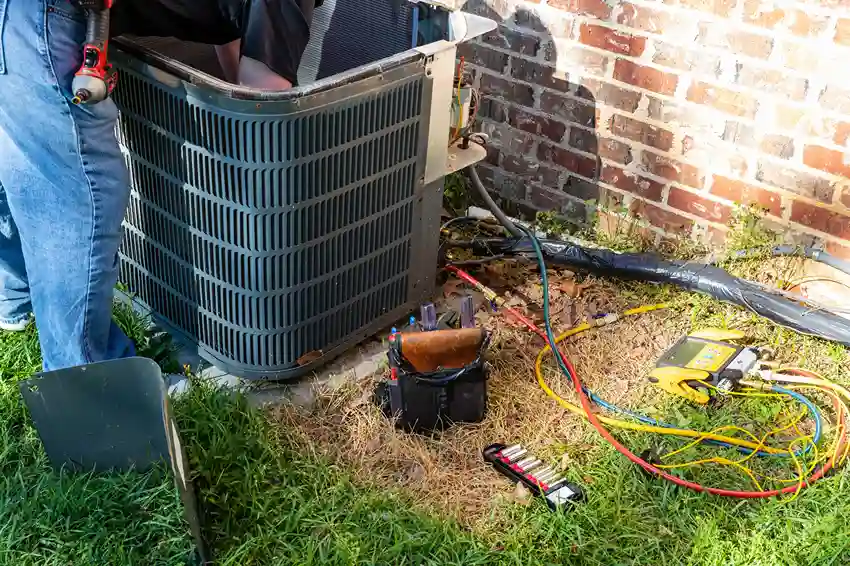
The Diagnostic and Repair Process
Understanding how a technician approaches your cooling issue helps you make informed decisions. The process is systematic, designed to isolate variables and pinpoint the exact failure point. This structured approach prevents misdiagnosis, which can lead to unnecessary parts replacement and wasted money.
Initial Assessment and Safety Check:
The process begins with a conversation about the symptoms you noticed—strange noises, smells, or specific times of day the unit struggles. The technician then disconnects power to perform a safe electrical inspection. This step ensures that the breaker, disconnect box, and internal wiring are safe to handle and compliant with local codes.
Component Testing:
Next, the technician uses specialized gauges and multimeters to test individual components. This includes measuring the amperage of the compressor and fan motor to see if they are overworking. They check the microfarad readings on the capacitors. If the system is running but not cooling, they attach pressure gauges to read the subcooling and superheat levels, which indicate exactly how the refrigerant is moving through the system.
Locating the Fault:
Once the data is collected, the fault is isolated. It might be a seized fan motor, a burnt-out compressor, or a leak in the evaporator coil. If a leak is suspected, electronic leak detectors or UV dye may be used to find the microscopic hole in the copper tubing.
Execution of Repairs:
After you approve the scope of work, the repair is performed. This involves removing the faulty part, installing the new component, and securing all connections. If refrigerant work is involved, the technician will braze connections and pull a vacuum on the lines to remove moisture before recharging the system.
System Validation:
Finally, the system is powered back on. The technician monitors the system for a full cycle to ensure the temperature drop (delta T) across the coil is correct. This verifies that the unit is actually cooling the air and removing humidity as intended.
Deciding Between Repair and Replacement
One of the most difficult decisions a homeowner faces is whether to pour money into an existing system or invest in a new one. This decision should not be based on pressure, but on data and financial logic. There are specific thresholds where repair becomes a poor investment compared to replacement.
Carter Heating and Cooling provides the honest assessments required to make this choice. You should consider the age of the equipment. Most air conditioners have a lifespan of 10 to 15 years. If your unit is nearing or has surpassed this age, a major failure like a compressor burnout is often a signal that the system has reached the end of its useful life.
Consider the "50% Rule" as a guideline for your decision:
- If the cost of the repair approaches 50% of the value of a new system, replacement is generally the better financial option.
- If the unit requires frequent repairs—meaning you are calling for service multiple times a year—those costs accumulate rapidly and often exceed the monthly cost of financing a new, more efficient unit.
Energy efficiency is another critical factor. Older units, particularly those manufactured before 2010, likely use R-22 refrigerant, which is phased out and incredibly expensive to replace. Modern systems use R-410A or newer refrigerants and operate at much higher SEER (Seasonal Energy Efficiency Ratio) ratings. Swapping a 10 SEER unit for a 16 SEER unit can result in significant reduction in monthly energy bills, which helps offset the cost of installation over time.
Listen to the sounds your unit makes. Grinding, squealing, or banging usually indicate severe mechanical wear. While a motor can be replaced, these sounds often point to systemic wear that will result in another failure shortly after the first repair.
Regional Climate Factors Affecting Your AC
Operating an air conditioner in Smiths Grove presents specific challenges due to the local climate and geography. The region experiences hot, humid summers with highs frequently reaching into the 90s. This humidity places a distinct load on your cooling equipment. Your AC does two jobs: it cools the air and it removes moisture. In this area, the latent heat load (humidity) is often just as taxing as the sensible heat load (temperature).
High Humidity Impact:
When humidity is high, your system must run longer cycles to pull moisture out of the air. If a system is short-cycling (turning on and off too quickly), it will cool the house but leave it feeling clammy. This is often a sign of an oversized unit or a dirty coil. Proper repair ensures the unit runs long enough to dehumidify effectively.
Storm Hazards:
Spring and summer in this part of Kentucky often bring thunderstorms. Lightning strikes and power surges are common causes of AC failure. A surge can fuse contactors or blow capacitors instantly. We frequently recommend and install surge protectors specifically for HVAC equipment to prevent these instant failures.
Seasonal Debris:
The local flora contributes to system clogging. Cottonwood, grass clippings, and pollen can coat the outdoor condenser coil. This creates a blanket that traps heat inside the unit, forcing the compressor to work harder and run hotter. Regular maintenance and repair visits often reveal that a simple lack of airflow due to debris is the primary cause of efficiency loss.
Permits and Regulations:
HVAC work in Kentucky is regulated to ensure safety and environmental protection. Handling refrigerants requires EPA certification. Structural modifications or major electrical work associated with HVAC repairs may require adherence to local building codes. Hiring a professional ensures that all work is documented and compliant, preserving the value of your home and the validity of your manufacturer’s warranty.
Why Professional Licensing Matters
The difference between a lasting repair and a temporary patch often comes down to the qualifications of the technician. Modern HVAC systems are complex machines involving high-voltage electricity, high-pressure gases, and intricate electronic controls. Attempting DIY repairs or hiring unlicensed handymen exposes homeowners to significant risks, including voided warranties and safety hazards.
Professional technicians carry the necessary licensure to operate in Kentucky. This license is proof of competency in thermodynamics, electrical safety, and code compliance. It guarantees that the person working on your equipment understands the science behind the cooling cycle.
Key advantages of professional service include:
- Accurate Diagnostics: Professionals use calibrated tools to read system pressures and temperatures accurately. Guessing leading to "parts changing" is eliminated.
- Warranty Preservation: Most equipment manufacturers explicitly state that warranties are void if repairs are not performed by a licensed professional. Using a certified service protects your coverage.
- Fully Stocked Trucks: A professional service vehicle is a mobile warehouse. It carries the most common capacitors, relays, motors, and refrigerants. This increases the likelihood that your repair can be completed in a single visit, restoring comfort immediately.
- Liability Coverage: Licensed contractors carry insurance. If an accident occurs during the repair, the homeowner is not held liable. This peace of mind is part of the service.
Ensuring Long-Term System Reliability
Once a repair is completed, the focus shifts to maintaining that performance. A repaired system can run efficiently for years if the underlying issues are resolved. The goal of any service visit is to leave the unit in a condition where it can handle the peak summer loads without strain.
You should expect transparency regarding the health of your system. If a part is replaced, you should understand why it failed. Was it age? Was it a power surge? Was it lack of maintenance? Understanding the cause helps prevent recurrence.
We believe in empowering homeowners with information. When you understand how your system works and what creates strain, you can take proactive steps—like regular filter changes and keeping the outdoor unit clear—to minimize future downtime.
Restoring Your Comfort Today
A broken air conditioner disrupts your life, impacts your sleep, and can make your home uninhabitable during the peak of summer. You need a solution that is fast, technically sound, and financially transparent. Waiting for a slow response or dealing with vague pricing is not an option when the heat index rises.
We provide the technical expertise and rapid response required to get your cooling system back online. From minor electrical fixes to major compressor repairs, the work is done right the first time. Do not let the heat compromise your comfort or safety any longer.
Carter Heating and Cooling is ready to diagnose your system and provide the solution you need. Contact us now to schedule your repair service and restore cool, conditioned air to your home.

Great Service at a Fair Price
Veterans Discount


Senior Discount

Law Enforcement

Fire fighters/ems

Hear From Your Neighbors!
Hear from your neighbors to see how our commitment to dependable service and lasting comfort has made a difference in their homes.