
How can we help today?
Choose an option to see quick actions and get help faster.Emergency Heating in Scottsville, KY
Emergency Heating in Scottsville, KY
Need fast heating repair in Scottsville? Get immediate 24/7 emergency service by certified experts. Call now to restore warmth and safety to your home.
When Your Heat Fails in Freezing Temperatures
Winters in Scottsville can drop to chilling lows, and waking up to a cold house is more than just an inconvenience; it can be a safety hazard for your family and your plumbing. When your heating system breaks down in the middle of the night or during a weekend cold snap, you need a solution immediately, not days from now. Contact us immediately to schedule emergency service or apply for financing to handle unexpected repairs:
- Get immediate, 24/7 emergency heating repairs regardless of the time or day.
- Benefit from certified technicians who carry the necessary parts to ensure a same-day solution.
- Experience the reassurance of a service backed by solid local testimonials regarding speed and accuracy.
- Licensed, insured, and customer-approved to put your comfort first.
Restoring Comfort and Safety to Your Home
A heating failure is rarely a planned event. It usually happens when the system is under the most stress, which coincides with the coldest nights of the year. The primary objective of emergency heating service is to diagnose the root cause accurately and restore safe operation as quickly as possible. When a technician arrives at your home in Scottsville, the focus is on triage and resolution.
The process begins with a comprehensive diagnostic check. Unlike routine maintenance where the goal is optimization, emergency diagnostics focus on identifying the specific failure point that caused the shutdown. This might involve testing electrical circuits, checking gas pressure, or analyzing airflow obstructions. Modern heating systems are complex, integrating safety switches and electronic control boards that will shut the system down to prevent fire or carbon monoxide leaks. A professional technician navigates these safety protocols to determine if the lockout is due to a faulty component or a genuine safety risk.
Once the issue is identified, the repair process moves to immediate rectification. Service trucks are stocked with common failure components—such as igniters, flame sensors, capacitors, and pressure switches—to minimize the need for supply house runs. The goal is to get the heat back on during the initial visit. If a proprietary part is required that is not currently in stock, the technician provides temporary solutions where safe to do so, such as utilizing auxiliary heat strips in heat pump systems, while expediting the necessary part.
Comprehensive Diagnostics and Repair Capabilities
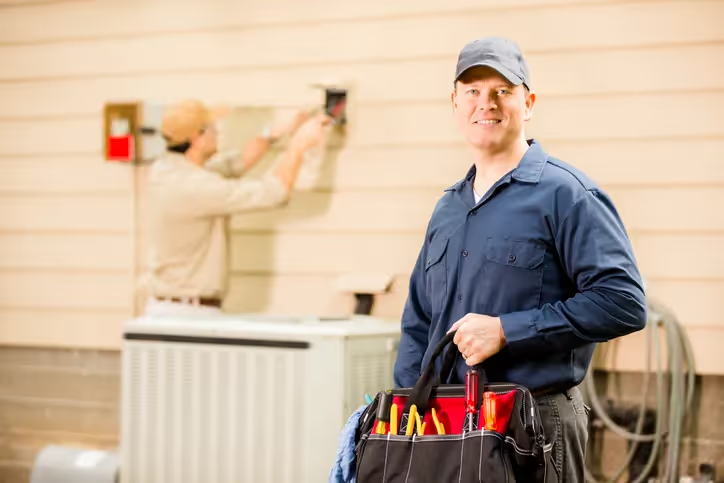
Effective emergency repair covers a wide spectrum of heating technologies. Homes in this region utilize a mix of gas furnaces, electric air handlers, and heat pumps. Each system presents unique failure modes that require specific technical knowledge to address:
- Gas Furnace Repairs: The most critical aspect of furnace repair is combustion safety. Issues often stem from ignition failures, such as a dirty flame sensor or a cracked hot surface igniter. Technicians also inspect the heat exchanger for cracks, which is a vital safety step to prevent carbon monoxide from entering the living space. Inducer motors, gas valves, and pressure switches are also common failure points that require immediate replacement.
- Heat Pump Services: In the Scottsville climate, heat pumps work hard during the winter. Common emergency calls involve the outdoor unit freezing up due to a faulty defrost board or reversing valve. If the compressor fails to start, it is often due to a start capacitor or a hard start kit requirement. Technicians verify refrigerant levels, as a leak can cause the system to blow cold air even when the thermostat calls for heat.
- Electric Heating Systems: For homes relying on electric resistance heating, the failure is often electrical in nature. Burnt-out heating elements, stuck sequencers, or tripped high-limit switches can render the system useless. Troubleshooting involves tracing high-voltage circuits to find the break in power delivery.
- Airflow and Thermostat Issues: Sometimes the heat source is functional, but the delivery system has failed. A failed blower motor means heat cannot be distributed, leading to system overheating and shutdown. Similarly, a malfunctioning thermostat may fail to send the signal to the heating unit. Technicians calibrate or replace thermostats and replace blower motors to restore circulation.
The Step-by-Step Emergency Repair Process
Understanding what happens during a service call helps alleviate the stress of the situation. The protocol is designed to be efficient, transparent, and respectful of your property:
- First, the dispatch team gathers initial details about the symptoms—such as strange noises, smells, or error codes on the thermostat—to ensure the technician is prepared before arrival.
- Next, upon arrival, the technician performs a site assessment. This includes checking the thermostat settings, inspecting the breaker panel, and accessing the heating unit. Drop cloths and shoe covers are used to protect your flooring during this process.
- Then, the technician utilizes diagnostic tools like multimeters and manometers to isolate the bad component. Once the problem is found, you receive a clear explanation of what failed and a flat-rate quote for the repair. No work begins without your approval.
- Afterward, the repair is executed. This may involve wiring new components, soldering connections, or mechanically replacing motor assemblies.
- Finally, the system is test-run through a full cycle. The technician measures temperature rise and checks safety limits to ensure the system is not only running but running safely. Carter Heating and Cooling ensures that when the truck leaves, your home is warming up.
Deciding Between Repair and Replacement
During an emergency service call, you may face the difficult decision of whether to repair the existing unit or invest in a replacement. This decision should be based on data and financial logic rather than the pressure of the moment. There are specific criteria that help determine the most cost-effective path forward:
- The 50% Rule: If the cost of the repair approaches or exceeds 50% of the value of the system (or the cost of a new unit), replacement is generally the wiser financial move.
- System Age: The average lifespan of a furnace or heat pump is 15 to 20 years. If your unit is over 12 years old and requires a major repair—like a compressor or heat exchanger—the money spent on repair acts as a temporary patch on a dying system.
- Frequency of Breakdowns: If this is the second or third service call in a single season, the system has become unreliable. Cumulative repair costs can quickly eclipse the monthly payment of a new, high-efficiency system.
- Safety Violations: A cracked heat exchanger in a gas furnace is a non-negotiable red flag. Because this poses a direct threat of carbon monoxide poisoning, the unit must be shut down. In this scenario, replacement is almost always the only safe option.
- Efficiency Considerations: Older units often operate at 60% to 70% efficiency (AFUE). Modern systems can reach up to 98% efficiency. Replacing an aging unit can result in immediate utility bill reductions that help offset the installation cost.
Local Climate and Infrastructure Factors
Operating a heating system in Scottsville presents specific challenges due to the regional climate and infrastructure. The humid subtropical climate means that winters are generally mild but can be punctuated by severe cold fronts and ice storms. These fluctuations put significant strain on heating equipment:
- Humidity and Ductwork: The high humidity levels year-round can affect ductwork located in crawlspaces or attics. Insulation on ductwork can become damp, leading to thermal loss. During winter, if the ductwork is compromised, the heating system has to run longer to maintain the set temperature, increasing wear and tear.
- Heat Pump Defrost Cycles: Because the region often hovers around freezing with high moisture content in the air, heat pumps are prone to frost accumulation on the outdoor coil. A functioning defrost cycle is critical here. If the defrost control fails, the unit turns into a block of ice, stopping heat transfer completely.
- Power Fluctuations: Rural areas surrounding the city can experience power fluctuations or brownouts during storms. These voltage irregularities can damage sensitive electronic control boards in modern furnaces and heat pumps. Installing surge protection is often recommended during repairs to prevent recurrence.
- Utility Access: Depending on your specific location, you may rely on natural gas, propane, or electricity. Propane systems require diligent monitoring of fuel levels, as running a tank dry can cause pilot outages and require a professional system bleed and restart.
Why Professional Service is Non-Negotiable
Attempting DIY repairs on heating systems is dangerous and often ends up costing more in the long run. Modern heating equipment operates with high-voltage electricity, combustible gases, and high-pressure refrigerants:
- Safety Compliance: Licensed professionals understand local building codes and safety standards. They know how to handle gas lines and exhaust venting to ensure dangerous fumes are expelled from the home.
- Warranty Preservation: Most equipment manufacturers require proof of professional service to maintain the parts warranty. Specific DIY attempts can void these warranties, leaving you liable for the full cost of future parts.
- Proper Tooling: Diagnosing a cracked heat exchanger or a failing compressor requires specialized tools that are not available to the average homeowner. Guessing which part is broken often leads to replacing functioning parts unnecessarily.
- Carbon Monoxide Detection: Professionals carry sensitive gas detection equipment to verify that combustion is clean and contained. This is a life-safety service that goes beyond simple temperature control.
Restoring Warmth to Your Home
When the temperature drops and your system fails, the priority is clear: fast, reliable, and safe resolution. Delays can lead to frozen pipes and potential water damage, compounding the cost of the initial heating failure. You need a partner who understands the urgency of the situation and has the logistical capability to respond instantly.
Choosing a service provider involves looking for transparency in pricing, technical certification, and a track record of solving problems on the first visit. Carter Heating and Cooling focuses on minimizing your downtime and maximizing the longevity of your heating investment through precise diagnostics and expert repair work.
Don't wait until the house is freezing to take action. Secure your comfort and safety now — schedule service today. Call immediately to dispatch a technician to your home.

Great Service at a Fair Price
Veterans Discount


Senior Discount

Law Enforcement
Fire fighters/ems
Hear From Your Neighbors!
Hear from your neighbors to see how our commitment to dependable service and lasting comfort has made a difference in their homes.