

How can we help today?
Choose an option to see quick actions and get help faster.Whole House Dehumidifier Installation in Plum Springs, KY
Whole House Dehumidifier Installation in Plum Springs, KY
Reduce indoor humidity with professional dehumidifier installation in Plum Springs. Latest technology and expert service. Call now for a dry, comfortable home!
Combat High Humidity in Your Home with Professional Dehumidifier Installation
Living with constant dampness inside your home creates an environment that feels sticky, smells musty, and compromises your comfort. High humidity does more than just make the air feel heavy; it actively degrades your indoor air quality and threatens the structural integrity of your property in Plum Springs. Carter Heating and Cooling is ready to assess your indoor climate needs and provide a permanent solution; contact us today to discuss financing options or schedule your installation.
When the outdoor humidity rises, your standard air conditioner often struggles to keep up, leaving you cold but clammy. A dedicated whole-house dehumidifier works in tandem with your existing HVAC system to mechanically remove excess moisture, ensuring your home remains dry and comfortable regardless of the weather outside. This is a crucial investment for maintaining a healthy living space.
- Quickly reduce indoor humidity levels to comfortable and healthy standards between 30% and 50%.
- Protect your home's wood flooring, drywall, and furnishings from warping, rot, and moisture damage.
- Enhance overall air quality by inhibiting mold growth and reducing dust mites and allergens.
Our licensed professionals handle all necessary permits, electrical connections, and ductwork modifications, with flexible financing available for qualified homeowners.
What You Get with Our Dehumidifier Installation Service
Choosing a whole-house solution is fundamentally different from buying a portable unit from a big-box store. Our service provides a fully integrated system designed to treat the air in every room of your house, not just a single damp corner. When you schedule an installation in Plum Springs, you are investing in a comprehensive humidity control strategy that operates automatically and efficiently.
We provide a complete setup that includes the unit itself, specifically sized for your home’s square footage and thermal characteristics. The service encompasses the fabrication of transition ductwork to blend the dehumidifier seamlessly into your supply or return air plenum. We also install a dedicated drainage system, often involving a condensate pump or gravity drain routed to the exterior or a utility sink, eliminating the need to ever empty a bucket again.
Control systems are another critical component included in our service. We install modern, digital humidistats or integrate the dehumidifier controls into your existing smart thermostat. This allows you to set a precise humidity percentage—typically around 45% or 50%—and let the system do the rest. You receive a "set it and forget it" solution that monitors indoor dew points and activates only when necessary.
Additionally, our installation covers all electrical requirements. These units often require a dedicated circuit to operate safely and meet local building codes. We ensure that the power supply is consistent and grounded, protecting the equipment from surges and ensuring reliable operation during the peak humid seasons.
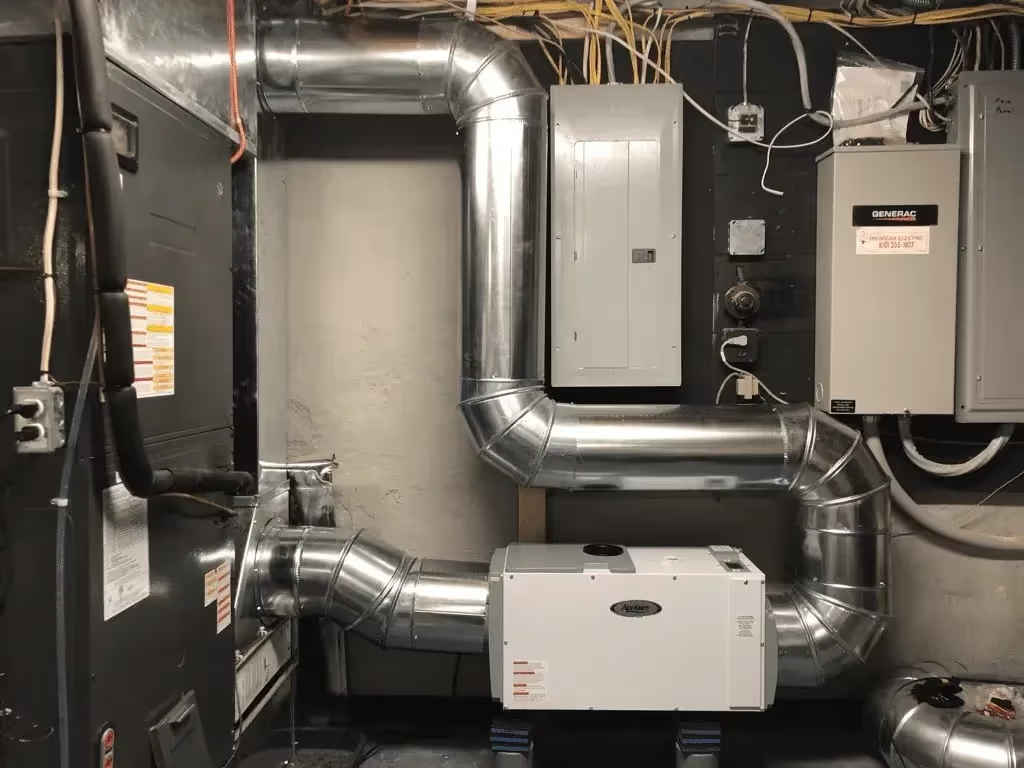
Dehumidifier Installation: How It Works
A professional installation is a multi-step process that requires HVAC expertise to ensure the system functions correctly without disrupting your heating and cooling airflow. We adhere to a strict protocol to guarantee maximum efficiency and equipment longevity — visit our FAQ for details.
- Site Assessment and Sizing
The process begins with a load calculation. We measure your home’s volume and assess the tightness of the building envelope. A drafty home in Plum Springs requires a different capacity than a tightly sealed new build. We determine the pint-per-day capacity required to maintain optimal humidity levels.
- Location Selection
We identify the best location for the unit, usually in the basement, crawl space, or attic near the central HVAC unit. The goal is to minimize noise while maximizing access for future filter changes and maintenance.
- Ductwork Fabrication and Connection
Technicians cut into the existing ductwork to create a bypass or independent circulation path. We install dampers and metal transitions to direct air through the dehumidifier. This step is critical; improper ducting can cause back-pressure that damages your main HVAC blower.
- Drainage Setup
Proper water removal is essential. We pipe the condensate line to a floor drain, sump pump, or outside line. If gravity drainage isn't possible due to the unit's location, we install a condensate pump to push the water to the appropriate discharge point.
- Electrical Integration
We wire the unit into your home’s electrical panel. This often involves running new wire and installing a breaker to support the amperage load of the dehumidifier.
- System Commissioning and Testing
Once physically installed, Carter Heating and Cooling technicians run the system through a full cycle. We verify that the unit triggers at the set humidity level, that the fan interlock functions correctly (turning on the HVAC blower if needed), and that water is draining properly without leaks.
Why Whole-House Systems Outperform Portables
Homeowners often debate whether to buy multiple portable units or invest in a whole-house system. While portables have their place for spot-treatment, they are inefficient for total home moisture control. Understanding the mechanical differences helps clarify why an integrated installation is the superior choice for long-term results.
- Efficiency and Capacity
A whole-house unit removes significantly more water per kilowatt-hour of electricity consumed compared to portable units. A standard integrated unit can remove 70 to 130 pints of water per day, whereas portables struggle to hit half that volume while generating significantly more heat and noise in the living space.
- Air Filtration
Integrated systems come with high-merv filtration. As air passes through the dehumidifier, it is not just dried; it is filtered. This means the air circulating through your ducts is cleaner, trapping particles that portable units simply blow back into the room.
- Maintenance Requirements
Portable units require daily attention. If you forget to empty the bucket, the unit shuts off, and humidity rises immediately. Integrated systems drain automatically. The only maintenance required for a whole-house system is an annual filter change and a coil cleaning, usually performed during your standard HVAC tune-up.
- Noise Control
Dehumidifiers contain compressors, which are inherently noisy. With a portable unit, that noise is in your bedroom or living room. With a whole-house installation, the noise is isolated in the mechanical room, crawl space, or attic, resulting in a silent solution for the occupants.
Choosing Installation Over Repair: A Cost-Benefit Guide
If you currently have a dehumidification system that is failing, or if you are relying on older portable units, you face the decision of whether to repair or replace. Making the right financial decision depends on the age of the equipment and the nature of the failure.
- Compressor Failures
If the compressor in an existing unit fails, replacement is almost always the more economical choice. The cost of a new compressor, combined with the labor and refrigerant handling, frequently exceeds 60% of the cost of a new, more efficient unit with a fresh warranty.
- Refrigerant Leaks
Locating and sealing a leak in an older coil is difficult and often temporary. If your current system has lost its charge, it is usually a sign that the coils have corroded. Installing a new unit ensures you have modern, corrosion-resistant aluminum coils that last longer.
- Age of the Equipment
Dehumidifiers generally have a lifespan of 10 to 15 years. If your unit is approaching the decade mark and requires a significant repair (like a fan motor or control board), the money is better spent on a new installation. Newer models are more energy-efficient, lowering your monthly utility bills immediately.
- Inadequate Sizing
Sometimes a unit isn't broken, but it is undersized for the moisture load. If your current system runs 24/7 but never reaches the set point (e.g., the humidity stays at 60% despite the setting being 50%), repair cannot fix this. You need to install a unit with a higher pint-per-day capacity to handle the load effectively.
Local Installation Requirements and Seasonal Considerations
Installing a whole-house dehumidifier in Plum Springs requires knowledge of local building codes and climate patterns. Our region experiences a humid subtropical climate, meaning we have significant moisture loads for a large portion of the year, particularly from late spring through early autumn.
- Permitting and Codes
Modifying your HVAC system and adding electrical circuits are regulated activities. We ensure that all wiring meets the National Electrical Code (NEC) standards adopted by local authorities. This includes proper grounding and the use of disconnect switches where required for safety and serviceability.
- Combustion Safety
Many homes in the area utilize gas furnaces or water heaters. When installing a dehumidifier, specifically one that ties into return ductwork, it is vital to ensure that the negative pressure created doesn't backdraft combustion gases into the living space. We perform static pressure testing to guarantee that your home remains safe.
- Crawl Space Considerations
In our area, many homes are built on crawl spaces. These are primary sources of humidity infiltration. Installing a dehumidifier often goes hand-in-hand with crawl space encapsulation. If the unit is installed in the crawl space, it must be rated for that environment and elevated off the ground to prevent flood damage and allow for proper drainage gradients.
- Seasonal Timing
The best time to install is before the heavy rains of late spring. Once the ground becomes saturated, hydrostatic pressure pushes moisture through foundations, spiking indoor humidity. Installing early ensures your system is ready to combat the initial surge of moisture, protecting your hardwood floors from the expansion and cupping that happens during the first humid weeks of the season.
The Impact on Home Energy Performance
Beyond comfort, installing a dehumidifier has a direct impact on how your home consumes energy. High humidity holds heat more effectively than dry air. This is why a 75-degree day feels oppressive when humidity is high (the heat index).
- Reduced AC Runtime
When the air is dry, you feel cooler at higher temperatures. You might set your thermostat to 72°F in a humid house to feel comfortable. In a dry house, 75°F feels just as cool. For every degree you raise your thermostat during the summer, you save a significant percentage on cooling costs. The dehumidifier allows your AC to focus on cooling the air rather than wasting energy trying to remove moisture.
- Shoulder Season Efficiency
During the spring and fall in Plum Springs, temperatures are often mild, but humidity remains high. In these "shoulder seasons," your air conditioner may not run enough to remove moisture, leading to a clammy house. A whole-house dehumidifier runs independently of the AC, keeping the home dry and comfortable without overcooling the space or running the energy-intensive AC compressor unnecessarily.
Our Commitment: Fast Service and Reliable Results
We understand that when you decide to address humidity issues, you want a solution that works immediately and lasts for years. We focus on technical precision and respect for your property throughout the installation process — read our reviews for assurance.
- Technical Expertise
Our technicians are trained in airflow dynamics and psychrometrics (the study of air and moisture). We do not guess at sizing or duct placement. We use industry-standard calculations to ensure your system performs exactly as promised.
- Clean and Professional
Modifying ductwork can create dust and debris. We take measures to protect your flooring and workspace. When we leave, the only evidence of our presence is the improved air quality and the new control panel on your wall.
- Transparent Process
From the initial quote to the final walkthrough, we provide clear information on what is being installed and how to operate it. We walk you through the filter change process and explain the warranty coverage on both parts and labor.
Schedule Your Dehumidifier Installation Today
High humidity is a solvable problem. By controlling moisture, you protect your property and improve the health of your indoor environment. Carter Heating and Cooling is prepared to deliver the expertise and equipment necessary to keep your home dry year-round. Don't let moisture compromise your home any longer; call us now to schedule your installation service.

Great Service at a Fair Price
Veterans Discount


Senior Discount

Law Enforcement

Fire fighters/ems

Hear From Your Neighbors!
Hear from your neighbors to see how our commitment to dependable service and lasting comfort has made a difference in their homes.